
About this publication
Every decision solves a problem. Some are remarkably good at creating the next one.
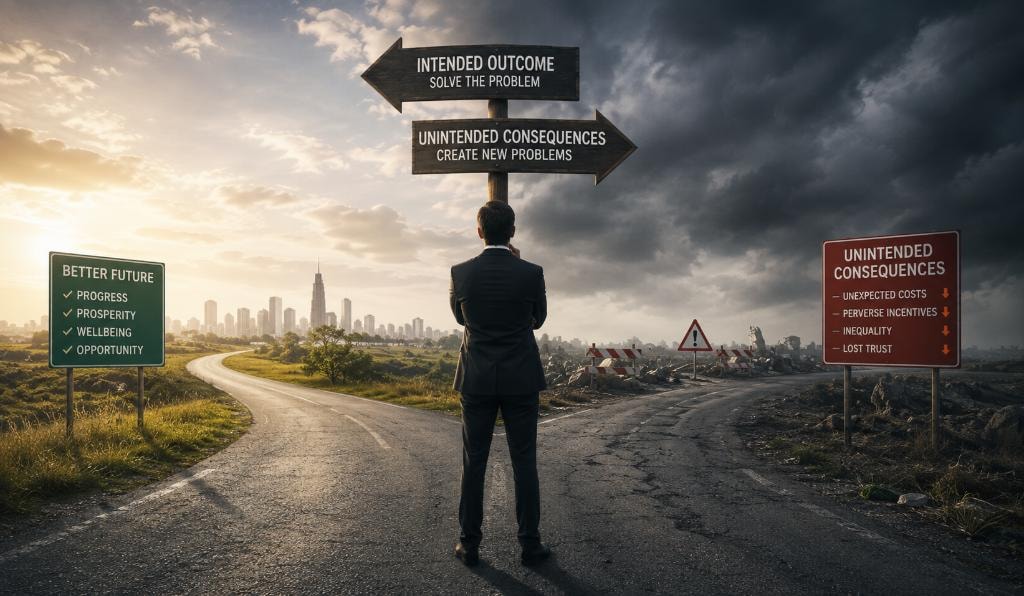
Unintended Consequences is about what happens after the decision has been made, the announcement applauded, the policy launched and everyone responsible has moved confidently on to the next meeting.
About Unintended Consequences
Unintended Consequences is about what happens after the decision has been made, the announcement applauded, the policy launched, the target set and everyone responsible has moved confidently on to the next meeting. It looks at the gap between what people intended to happen and what actually happened.
Governments introduce policies designed to make life better. Companies launch initiatives intended to improve performance. Regulators create rules to protect us. Experts identify problems and prescribe solutions. Campaigners demand action. Management teams set targets. Most of them start with perfectly reasonable intentions. And then reality gets involved.
A tax designed to raise revenue changes behaviour and raises rather less than expected. A regulation intended to protect consumers makes the service more expensive. A target designed to improve performance encourages people to game the measurement instead. A subsidy makes something affordable and promptly helps push up its price. A warning system designed to alert everybody becomes so commonplace that eventually nobody pays much attention to it.
The fascinating part is that these outcomes often aren't particularly surprising. They happen because human beings respond to incentives, avoid inconvenience, exploit loopholes, follow fashions, protect their own interests and occasionally behave in ways that apparently failed to appear on the committee's spreadsheet.
The question we keep asking: at the heart of Unintended Consequences is a very simple question — what did they think was going to happen? Not because every bad outcome could have been predicted. Not because decision-makers are necessarily incompetent. And not because hindsight makes us cleverer than the people who had to make the decision at the time. But some consequences really were foreseeable. Sometimes the warning signs were there. Sometimes economists, scientists, businesses or ordinary members of the public pointed them out. Sometimes exactly the same mistake had been made before. And sometimes enthusiasm for doing something appears to have overwhelmed the rather less exciting business of asking what might happen next.
Good intentions are not the same as good outcomes. We have developed a peculiar habit of judging decisions by their intentions. A policy is compassionate because it was intended to help people. A regulation is sensible because it was introduced to prevent something undesirable. A corporate initiative is progressive because its objectives sound progressive. But intentions don't pay the bill. Outcomes do. A well-intentioned decision can still produce a dreadful result. Equally, an unpopular or uncomfortable decision can sometimes produce benefits that only become obvious years later.
That distinction matters because the modern world has become exceptionally good at announcing intentions and considerably less enthusiastic about returning a few years later to examine the results. Unintended Consequences does exactly that.
Politics, business and everyday absurdity. Politics inevitably provides rich material because governments make enormous decisions affecting millions of people, usually accompanied by impressive forecasts explaining precisely what will happen next. Reality has an irritating habit of declining to read them. But this isn't a party-political website. Conservative governments have produced spectacular unintended consequences. Labour governments have managed some excellent examples of their own. American politicians are equally accomplished. Regulators, central banks, local councils, businesses, universities, technology companies and the rest of us are perfectly capable of joining in. Human folly has always been admirably non-partisan.
The articles examine the original problem, the proposed solution, why it seemed sensible at the time, what actually happened and, most importantly, why the difference matters. Sometimes the consequences are serious. Sometimes they're expensive. Sometimes they're merely ridiculous. The best examples manage all three.
This isn't a think tank. There is no grand ideology lurking behind the site. Unintended Consequences isn't trying to tell you how to vote, what to believe or which tribe to join. There are already quite enough people doing that. Nor is it an academic journal. The aim isn't to bury a simple idea beneath twenty-seven pages of terminology until nobody outside the profession can understand it. The aim is much simpler: take an interesting decision, understand why it was made, follow what happened next, compare the result with the intention, and occasionally marvel at the difference.
That requires evidence, context and a willingness to accept that the answer isn't always convenient. Sometimes the people we disagree with turn out to have been right. Sometimes the people we agree with make a complete mess of things. That's rather the point.
Why Unintended Consequences? Because consequences matter more than announcements. Because incentives matter more than slogans. Because human behaviour rarely conforms neatly to a policy document. And because before making the next enormous decision intended to improve the world, it might be worth spending five minutes examining what happened after the last one. There is an old principle that says we should learn from our mistakes. Humanity has developed a rather more ambitious system. We document them, commission a review, rename the policy and try again. Welcome to Unintended Consequences. The story doesn't end when the decision is made. That's usually where it begins.
Our Principles
Intellectual Honesty
We follow the evidence, not the narrative. When the data contradicts our priors, we update our priors.
The Seen and Unseen
Every policy has visible effects and invisible ones. We examine both — especially the ones that don't make headlines.
Second-Order Thinking
We ask not just what a policy does, but what it does next. And after that. Complexity is not an excuse for shallow analysis.
Editorial Independence
No advertisers, no party affiliations, no ideological patrons. Our analysis is accountable only to the facts.
Robert Woodland-Ferrari
Founder
Unintended Consequences is an independent commentary site examining what happens when apparently sensible decisions collide with reality. It was created by Robert Woodland-Ferrari, a businessman and entrepreneur with more than 50 years' experience of watching decisions produce results that weren't quite in the original PowerPoint presentation.
It isn't aligned with a political party. Governments of every persuasion are capable of getting things spectacularly wrong.
Read with us
Analysis delivered to your inbox. No noise, no agenda — just rigorous examination of policy and its consequences.
No spam. Unsubscribe at any time.