
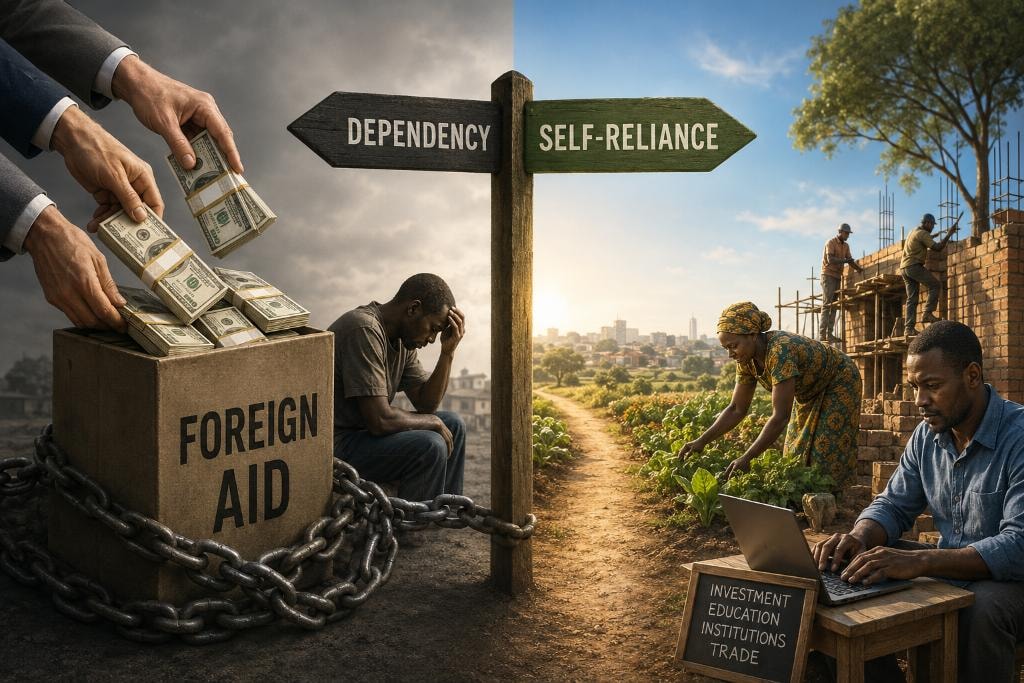
Foreign aid begins with one of the most defensible intentions in public policy. A wealthy country sees poverty, hunger, disease or inadequate infrastructure elsewhere and decides that some of its resources should be used to help. In emergencies, the case can be overwhelming. Food after a famine, shelter after an earthquake, vaccines during an epidemic and medical assistance in countries without adequate health systems can save lives immediately. The difficulty begins when emergency assistance evolves into something quite different: a permanent economic relationship in which governments, institutions and sometimes entire sectors become accustomed to money arriving from somewhere else.
This is the uncomfortable paradox at the heart of development aid. A policy intended to help countries become stronger can, if badly designed or continued indefinitely, reduce the pressure to develop the institutions that would make them stronger.
From Reconstruction to Development
The modern enthusiasm for foreign assistance was heavily influenced by the success of the Marshall Plan after the Second World War. American support helped European economies rebuild damaged infrastructure and restore production and trade. It became an extraordinarily powerful example of what external financial assistance appeared capable of achieving.
But there was an important distinction. Western Europe already possessed functioning states, educated populations, commercial institutions, legal systems, tax structures and considerable industrial capacity. The Marshall Plan was primarily helping damaged economies recover. It was not attempting to construct modern economies almost from scratch.
Nevertheless, the apparent lesson was seductive: transfer sufficient money, expertise and technology to poorer countries and development should follow.
Over subsequent decades, foreign assistance became an enormous international undertaking involving governments, the United Nations, the World Bank, development agencies, charities, consultants and thousands of NGOs. OECD statistics show that official development assistance from its Development Assistance Committee members alone reached $214.6 billion in 2024. In 2025 it fell sharply to about $174 billion, the largest annual contraction recorded by the OECD. The sums involved remain enormous.
Yet the economic transformation expected from decades of assistance has been remarkably uneven.
The Dependency Problem
The problem is not simply that aid sometimes fails. Almost every form of government expenditure sometimes fails. The more serious concern is that aid can alter incentives.
Consider taxation. In successful states, governments ultimately depend upon their citizens and businesses for revenue. Taxation is rarely popular, but it creates an important relationship. Governments need productive economies capable of generating taxable income, while taxpayers reasonably expect competent government in return.
That relationship can contribute to political accountability.
But imagine a government able to finance a significant part of its activities from money supplied by foreign governments and international institutions. The relationship changes. Its financial survival becomes partly dependent upon satisfying donors rather than developing the domestic economy and satisfying taxpayers.
The intention was to strengthen the state. The unintended consequence can be to weaken one of the mechanisms that forces states to become effective.
Aid can also distort local markets. A well-funded international organisation can offer salaries far above those available in government departments, universities or local businesses. The best doctors, administrators, engineers and economists may therefore migrate towards organisations financed from overseas.
The country receives additional expertise, yet its own institutions can simultaneously lose talented people.
Once again, the paradox appears: the organisation established to strengthen local capacity can inadvertently compete with it.
When Free Becomes Expensive
There is another problem that appears repeatedly in humanitarian assistance: giving something away can destroy the market for producing it locally.
Imagine farmers struggling to establish a commercial agricultural sector. A humanitarian crisis occurs and enormous quantities of imported food arrive free of charge. The immediate humanitarian argument may be undeniable, but if free imports continue after the emergency has passed, local farmers are being asked to compete with a product whose price is effectively zero.
They cannot.
Similar problems can arise with donated clothing, equipment and other goods. What begins as relief can become competition with domestic producers.
This does not mean emergency food assistance should stop. It means policymakers must recognise the difference between saving people during a crisis and creating the conditions in which they can support themselves afterwards.
The first may require giving things away. The second usually requires functioning markets.
Confusing the two can turn temporary assistance into permanent dependency.
The Economic Distortion
Large foreign currency inflows can create broader economic distortions as well. Economists sometimes compare the effect with the so-called Dutch Disease, where substantial inflows of foreign currency contribute to exchange-rate pressures that make other domestic industries less competitive internationally.
Aid is not identical to a natural-resource boom and the evidence varies considerably between countries, but the underlying concern is real: very large external inflows can influence exchange rates, wages, government spending and the allocation of skilled labour.
An aid programme designed to stimulate development can therefore make it harder for some export industries to compete.
That matters because the countries that achieved some of the most spectacular economic transformations of the past half-century did not rely primarily on permanent aid flows. South Korea, Taiwan, Singapore and later China followed very different political and economic paths, but all placed enormous emphasis on production, exports, investment, infrastructure, education and participation in international trade.
Their development ultimately depended upon producing things that other people wanted to buy.
That sounds almost embarrassingly obvious. Economic policy has a remarkable ability to make obvious things complicated.
The Aid Industry Has Incentives Too
There is another unintended consequence that receives considerably less attention: the organisations delivering aid develop interests of their own.
Government development departments employ people. International organisations employ people. NGOs employ people. Consultants advise them. Contractors deliver programmes. Universities conduct research. Conferences are organised and reports commissioned.
An entire professional ecosystem develops around international development.
Most of the people involved may be entirely sincere. But institutions, like individuals, respond to incentives.
An organisation established to solve a problem rarely has a powerful institutional incentive to announce that the problem has been solved and that its own services are no longer required.
Success in development should ultimately mean the disappearance of the need for development assistance.
Yet aid organisations are normally rewarded for programmes delivered, money distributed and projects administered. Measuring whether a country has become genuinely less dependent on outside assistance is considerably harder.
This can create a subtle but important conflict between delivering aid and eliminating the need for it.
But Aid Has Also Worked
None of this justifies the simplistic conclusion that foreign aid is useless.
Some forms of assistance have produced extraordinary results. Vaccination programmes, malaria prevention, clean-water projects, maternal health initiatives, disaster relief and programmes combating infectious diseases have saved millions of lives. Targeted interventions can work particularly well when the objective is specific and measurable.
The mistake is therefore to discuss "foreign aid" as though it were one policy.
Providing vaccines is not economically equivalent to supporting a government budget for thirty years. Financing a water treatment plant is not the same as shipping free consumer goods into a functioning local market. Emergency famine relief is not the same as maintaining permanent subsidies.
The important question is not simply: Does foreign aid work? It is: Which forms of aid work, under what circumstances, for how long, and what happens when they end?
That produces a much less comfortable debate.
Trade Rather Than Permanent Assistance
Perhaps the most powerful development policy available to wealthy countries is also one of the least theatrical: allow poorer countries to sell them things.
Trade creates something aid frequently struggles to create: reciprocal economic relationships.
A factory exporting clothing must satisfy customers. A farmer exporting produce must meet quality standards. A technology company selling services internationally must develop skills. Successful businesses employ people, pay wages, generate tax revenues and encourage investment.
The money is earned rather than granted.
That distinction matters psychologically, economically and politically.
Foreign investment can have similar effects when accompanied by reasonable institutions and property rights. Capital arrives because investors believe productive activity can generate a return. Skills are transferred, workers trained and supply chains created.
This does not make international investment automatically benevolent. Exploitation, corruption and environmental damage are perfectly possible. But productive investment contains an important discipline that traditional aid often lacks: eventually the activity has to create economic value.
A Better Model of Assistance
The alternative to conventional aid is therefore not abandoning poorer countries. It is designing assistance around the objective of eventually making assistance unnecessary.
Emergency humanitarian relief should remain available because disasters do not wait for economic theory. Health programmes with clear, measurable outcomes deserve support where evidence shows that they work. Infrastructure projects capable of unlocking economic activity can be transformative. Carefully designed cash-transfer programmes can sometimes deliver assistance more efficiently than enormous administrative structures.
But longer-term development assistance should increasingly be judged against a much tougher question: Is this programme making the recipient country more capable of functioning without us?
If the answer remains no after ten, twenty or thirty years, continuing the same programme should not automatically be described as compassion.
It may simply be evidence that the policy has failed.
The Unintended Consequence
Foreign aid illustrates one of the recurring themes of public policy: good intentions do not guarantee good outcomes.
The intention was to transfer resources from wealthy societies to poorer ones so that poorer countries could accelerate their development. Sometimes that has happened. Sometimes aid has saved lives spectacularly and cheaply.
But elsewhere, prolonged assistance has risked weakening accountability, distorting markets, attracting skilled workers away from local institutions and allowing governments to postpone difficult economic reforms.
The greatest danger is therefore not that wealthy countries help poorer countries too much.
It is that we confuse helping people with creating systems that require our continued help.
The measure of a successful development policy should not be how much money was spent, how many programmes were launched or how many international organisations participated.
It should be whether, eventually, they are no longer needed.
That would be the ultimate success of foreign aid.
And perhaps its greatest institutional challenge.