
There is a tendency to think of unintended consequences as bad things.
Governments introduce a tax to raise revenue and discover that people change their behaviour. Regulators protect consumers and accidentally destroy competition. Subsidies designed to make something cheaper make it more expensive. A perfectly sensible intervention goes into the machinery of human behaviour and emerges somewhere nobody expected.
But unintended consequences can work the other way.
Sometimes failure produces something better than success.
Few examples demonstrate this as neatly, or as entertainingly, as Viagra.
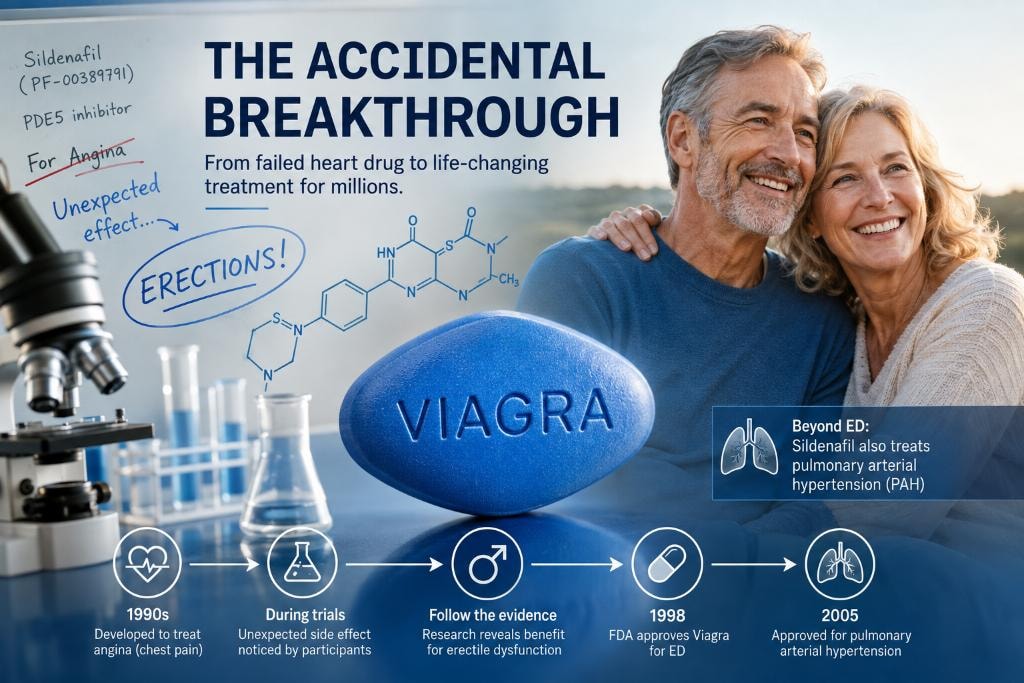
The little blue pill that became one of the most recognisable medicines in the world did not begin life as a treatment for erectile dysfunction. Sildenafil was developed by Pfizer researchers working on cardiovascular disease. The objective was to help the heart. What they discovered instead was that the drug had a particularly interesting effect somewhere else. And unlike so many stories of unintended consequences, this one had a remarkably happy ending.
The Drug That Didn't Work
During the 1980s and early 1990s, researchers at Pfizer's laboratories in Sandwich, Kent, were investigating compounds that could affect blood flow. One of them was sildenafil.
The scientific reasoning was perfectly respectable. Sildenafil inhibits an enzyme known as phosphodiesterase type 5, or PDE5. Through its effects on the nitric oxide and cyclic GMP pathway, the drug can relax smooth muscle and widen blood vessels. Researchers hoped this mechanism might make sildenafil useful for treating angina, the chest pain caused when the heart muscle does not receive enough oxygen-rich blood.
It was an entirely logical idea. Unfortunately, sildenafil was not particularly impressive as an angina treatment.
In pharmaceutical development, that normally leads to an unceremonious ending. Companies investigate thousands of compounds precisely because most of them will fail. A drug that doesn't perform adequately against its intended disease eventually joins the enormous graveyard of promising ideas that didn't quite work.
But something peculiar was happening during the sildenafil trials. The male participants were reporting an unexpected physiological effect. The drug was producing erections. More importantly, the effect was sufficiently consistent to suggest that this wasn't simply an amusing curiosity buried somewhere in the adverse-events paperwork. The failure was pointing towards another opportunity.
Follow the Evidence, Not the Original Plan
This is where the Viagra story becomes interesting beyond medicine. Pfizer could have treated the effect as an irrelevant side effect. After all, sildenafil had been created as a cardiovascular drug. Pharmaceutical research programmes have objectives, budgets, management structures and people whose careers become attached to particular outcomes. Organisations are remarkably capable of ignoring evidence that doesn't fit the original PowerPoint presentation.
Instead, researchers followed what the evidence was telling them. The mechanism made sense. An erection depends heavily on blood flow. Sexual stimulation releases nitric oxide, which increases levels of cyclic GMP and causes smooth muscle in the penis to relax. This allows increased blood flow into erectile tissue. PDE5 breaks down cyclic GMP. Sildenafil inhibits PDE5.
In simplified terms, sildenafil wasn't creating sexual desire. It was helping the body's natural erectile mechanism work more effectively when sexual stimulation occurred. The apparent side effect therefore had a biological explanation. A failed cardiovascular medicine was becoming a potentially revolutionary treatment for erectile dysfunction.
A Problem Medicine Had Struggled to Treat
It is easy today to underestimate what erectile dysfunction treatment looked like before Viagra. The condition was widespread, but embarrassment surrounded it. Treatment options existed, but they were hardly convenient. Depending upon the cause and severity, men might be offered psychological treatment, injected medication, vacuum devices or surgically implanted prostheses. None offered quite the simplicity of swallowing a tablet.
There was another problem. Impotence, as erectile dysfunction was more commonly called, was often treated culturally as either a joke or an inevitable consequence of ageing rather than a legitimate medical problem. Yet erectile dysfunction can have profound consequences. It can damage confidence, relationships and intimacy. It may also be associated with underlying medical conditions including cardiovascular disease and diabetes.
Viagra helped change the conversation because suddenly there was a straightforward pharmaceutical treatment. The condition moved from something many men suffered silently to something they could realistically discuss with a doctor. That social consequence may have been almost as important as the pharmacological one.
1998: The Blue Pill Arrives
The US Food and Drug Administration approved Viagra for erectile dysfunction on 27 March 1998. The response was extraordinary. Pfizer describes Viagra as the first oral medicine approved for erectile dysfunction, and the drug rapidly became one of the most recognisable pharmaceutical brands on earth.
Clinical trials had produced substantial improvements compared with placebo. The original FDA prescribing information reported statistically significant improvements in measures of erectile function across a broad range of patients. The great attraction, however, was obvious without a statistical analysis. A difficult and deeply personal medical condition could now, for many men, be treated with a tablet taken before sexual activity. Medicine had converted something complicated into something relatively simple. Human beings tend to appreciate that.
The Unintended Consequence Multiplies
Then the story became even more appropriate for Unintended Consequences. Sildenafil had started as a cardiovascular drug. It failed in that role. Its unexpected sexual effects transformed it into Viagra. And researchers subsequently discovered that its ability to affect blood vessels had another important medical application after all.
Sildenafil became a treatment for pulmonary arterial hypertension, a serious condition involving abnormally high blood pressure in the arteries supplying the lungs. It is marketed for this purpose under the brand name Revatio.
So the journey effectively went: Heart and circulation drug → failed treatment → erectile dysfunction breakthrough → treatment for a serious circulatory disease. The original science had not been foolish. It had simply found its destination by an unexpectedly circuitous route.
Success Created Its Own Consequences
No successful innovation arrives without secondary effects, and Viagra was no exception. Its extraordinary popularity created an enormous market for competitors and imitators. Other PDE5 inhibitors followed, including tadalafil, better known as Cialis, and vardenafil, sold as Levitra. Eventually patents expired and inexpensive generic sildenafil became widely available. Treatment that had once been novel became routine.
There was also a less welcome consequence. The enormous demand for erectile dysfunction medicines created a lucrative counterfeit market. Fake Viagra became a familiar feature of dubious websites, spam emails and unregulated supplements. The irony is considerable. A medicine developed through rigorous scientific research became so desirable that an entire industry emerged selling products pretending to be it. Successful regulation had produced a safe medicine; successful marketing produced people willing to buy unsafe copies. Human ingenuity rarely confines itself to the socially useful variety.
It Wasn't an Aphrodisiac
Viagra also acquired a mythology that exceeded its pharmacology. The drug does not simply manufacture erections on command and it does not create sexual desire. Sexual stimulation is normally required for sildenafil to work. That distinction matters because Viagra's cultural reputation became larger than its actual medical function. It became shorthand for sexual performance, virility and even rejuvenation. The word itself entered popular culture.
Few prescription medicines achieve that level of recognition. Aspirin, perhaps. Valium. Prozac. Viagra joined a very small club in which a trademark became almost synonymous with the condition it treated. That was certainly not in Pfizer's original cardiovascular research plan.
The Risks Didn't Disappear
A positive unintended consequence does not mean a consequence-free medicine. Sildenafil can cause headaches, flushing, indigestion, nasal congestion and visual disturbances. More importantly, sildenafil must not be combined with nitrate medicines commonly used for angina because the combination can produce a dangerous fall in blood pressure. There are also rare but potentially serious adverse effects requiring medical attention.
The irony is difficult to miss. A medicine originally investigated for angina ultimately became a drug that some patients taking nitrate treatments for angina specifically must not use. Science does enjoy complicated endings. Yet this doesn't diminish the achievement. It demonstrates why medicines require proper testing even when their mechanism appears well understood. Discovering an unexpected benefit is only the beginning. Researchers still have to establish whether it actually works, for whom it works, what dose is appropriate and when it becomes dangerous.
The Economics of Accidental Discovery
There is another lesson in the Viagra story. Innovation is often described as if it were a predictable process: invest money into research, identify a problem, develop the solution, commercialise it, collect the return. Real innovation is considerably messier. Research produces dead ends. Experiments generate contradictory results. Products designed for one market find another. Technologies created to solve one problem become more valuable when applied somewhere completely different.
The critical resource is therefore not simply research expenditure. It is organisational curiosity. The important question when something unexpected happens is not: Why didn't the experiment work? It is also: What did happen? That subtle change of question can be worth billions.
Failure Is Information
This may be Viagra's most useful lesson. We normally divide outcomes into success and failure. But scientific failure is rarely that simple. An experiment that disproves a hypothesis has still produced information. A medicine that doesn't treat one condition may affect another biological mechanism. A technology rejected by its intended customers may solve another industry's problem. A business model that fails in one market may work perfectly somewhere else. Failure becomes waste only when nobody learns from it.
Pfizer's researchers had an advantage that policymakers, companies and individuals frequently lack: the unexpected result was measurable. Something was happening. The intelligent response was to investigate it.
The Opposite of the Usual UC Story
Most unintended consequences arise because somebody fails to anticipate how a complex system will react. Viagra represents almost the reverse. Researchers encountered an unexpected result and paid attention to it. That distinction is important.
The lesson is not that planning is pointless or that fortunate accidents will rescue bad ideas. It is that reality should be allowed to overrule the plan. Governments are notoriously reluctant to abandon policies because the consequences contradict the original theory. Businesses can behave similarly. Money has been invested, reputations committed and targets announced. Evidence that the original strategy isn't working becomes inconvenient. Science, at its best, works differently. The experiment gets a vote. And sometimes the experiment says: You were looking in the wrong place.
A Rather Successful Failure
Sildenafil failed to become the angina treatment its researchers originally hoped for. Judged against that objective, the project should have been disappointing. Instead, the unexpected biological effect observed during development led to Viagra, approved in the United States in 1998 and subsequently used by millions of men. The same compound later found an important role treating pulmonary arterial hypertension.
A failed cardiovascular medicine became a sexual-health revolution and then returned, in a different form, to cardiovascular medicine. There could hardly be a better example of a positive unintended consequence.
The wider lesson extends far beyond pharmaceuticals. Not every unexpected outcome is a problem to be corrected. Sometimes it is information pointing towards an opportunity nobody thought to look for. The clever part isn't predicting every consequence. That is impossible. The clever part is recognising the valuable ones when they appear.
About the author
Robert Woodland-Ferrari
Businessman, entrepreneur and lifelong observer of decisions that seemed like a good idea at the time.