Few government policies sound more obviously fair than the minimum wage. If somebody works for a living, they should receive a decent wage, and if employers can pay desperately low wages simply because workers have little bargaining power, government has good reason to intervene.
Britain introduced the National Minimum Wage in 1999 amid warnings that it would destroy large numbers of jobs. Those predictions proved substantially exaggerated. Employment continued to grow, low-paid workers benefited and successive governments became increasingly confident about raising the statutory floor.
What began cautiously has consequently become much more ambitious. From April 2026, Britain's National Living Wage for workers aged 21 and over is £12.71 an hour, while the rate for 18-to-20-year-olds has risen to £10.85. For someone working 37.5 hours a week, £12.71 represents almost £24,800 a year before tax.
That is unquestionably good news for somebody who previously earned less and continues working the same hours. But there is another worker who rarely appears in government announcements: the person who is never hired.
And that is where the unintended consequence begins.
Government Can Set the Wage, Not the Value of the Job
The fundamental problem is simple. Government can determine what an employer must pay an employee, but it cannot determine how valuable that employee is to the employer.
Imagine a small café considering employing an inexperienced 19-year-old on Saturdays. The owner knows the new employee will initially be slow, require supervision and need training. At a sufficiently low employment cost, taking that person on may be worthwhile. Increase the cost significantly and the calculation changes.
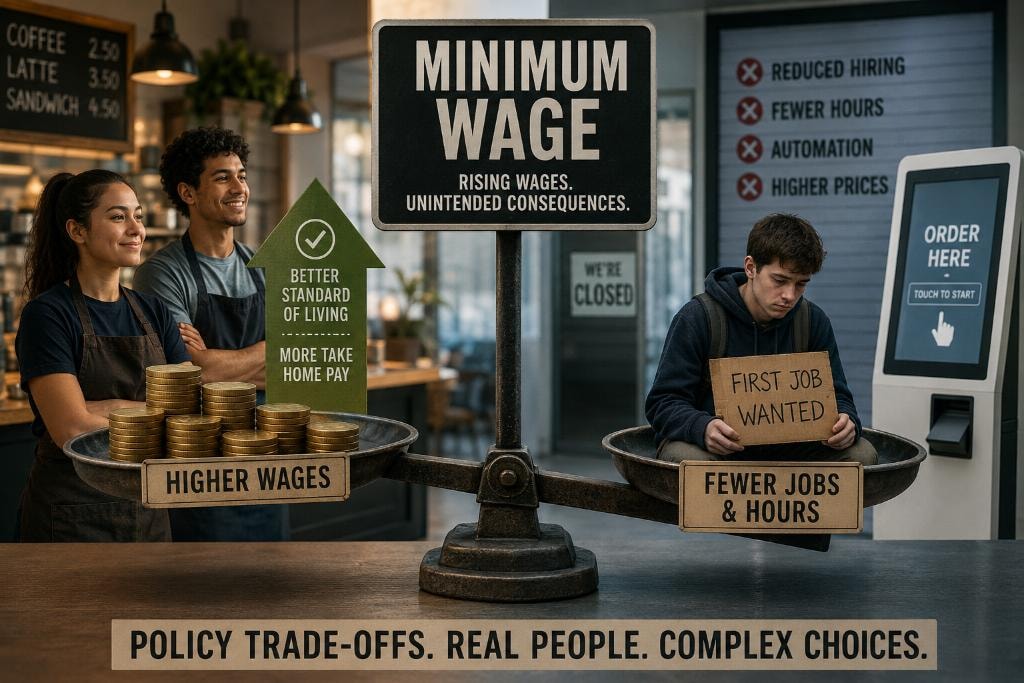
The café does not necessarily sack anybody. It simply doesn't employ the additional person. The owner works longer, existing employees cover more, opening hours may be shortened, customers order at a counter or technology replaces part of the process.
There is no redundancy announcement and therefore no obvious job loss to measure. There is simply one less job.
Multiply that decision across thousands of cafés, pubs, restaurants, shops, care providers, hotels and small businesses and the labour market gradually becomes less willing to employ people whose productivity is uncertain. Those are often precisely the people the minimum wage was intended to help.
The Missing First Rung
The greatest danger may therefore not be unemployment among established workers, but the disappearance of entry-level employment.
An experienced employee has references, skills and a work history. A teenager looking for a first job has none of those things. The same problem can affect someone returning after years outside the workforce, a person with poor qualifications or anyone trying to rebuild a working life after long-term unemployment.
Historically, employers could compensate for that additional risk with a lower starting wage. The employee accepted relatively low initial earnings in exchange for something potentially much more valuable: experience. Once acquired, that experience increased productivity and allowed the employee to command higher wages.
The first job was therefore not merely income. It was the entrance to the labour market.
Raise the price of that entrance too far and employers naturally become more selective about who gets through it. A law designed to protect vulnerable workers can inadvertently encourage employers to choose less vulnerable ones.
What the Evidence Actually Shows
Seattle provides one of the best-known experiments. As the city substantially increased its minimum wage, researchers found that hourly wages rose but hours worked in low-paid employment fell. Later research produced a more nuanced picture: workers already established in employment generally benefited, while less-experienced workers gained less and the hiring of new low-wage employees weakened.
That distinction matters. A minimum wage can benefit the insider who already has the job while making life more difficult for the outsider trying to get one.
Britain's experience is important too, because it contradicts the more extreme argument that minimum wages inevitably cause mass unemployment. Research into the UK minimum wage has generally found relatively small overall employment effects, while wages at the bottom have increased substantially.
But that does not prove that every future increase will be harmless. There must logically be a point at which the cost begins to affect behaviour. A minimum wage of £12.71 may be manageable; £20 would produce different consequences, and at £50 the effect would be obvious.
The important question is therefore not whether minimum wages destroy jobs, but where the level lies at which additional benefits begin to be outweighed by unintended consequences.
Nobody knows that number precisely.
Britain May Be Getting Closer
There are signs that employers are finding the calculation increasingly difficult. The Low Pay Commission has not found robust evidence of a significant overall negative effect on UK employment, but employers, particularly in retail and hospitality, increasingly report responding to higher wage costs through reduced recruitment and fewer hours.
This is precisely the effect policymakers should watch because it is almost invisible. A restaurant reducing its workforce from 20 people to 19 through natural turnover makes no newspaper headline. A retailer deciding not to replace somebody who leaves is not recorded as a redundancy. A pub asking three employees to cover work previously performed by four may even appear more productive.
Yet another employment opportunity has disappeared.
The Minimum Wage Isn't the Employer's Minimum Cost
There is another complication. The hourly wage is not what an employee actually costs.
Employers must also consider National Insurance, pension contributions, holiday pay, sick pay, training, administration and other employment costs. When government increases the minimum wage while also increasing employment taxes, the effects accumulate.
The employer is therefore not asking, "Can I afford £12.71 an hour?" The real question is, "Is employing this additional person worth the total cost?"
For a highly productive employee, the answer remains obvious. For a marginal position it may not, and marginal jobs are the first to disappear.
Automation, Prices and Fewer People
Self-service technology makes the change visible. Fast-food restaurants increasingly use ordering screens, supermarkets have self-checkouts, hotels encourage online check-in and banks have moved customers from branches to apps.
It would be too simplistic to claim that minimum wages caused this automation. Technology was heading in this direction anyway, and some research has found little evidence that higher minimum wages accelerated the introduction of restaurant ordering kiosks. What higher labour costs do, however, is change the relative attractiveness of alternatives to employing another person.
That alternative may be technology, outsourcing, customer self-service, shorter opening hours, redesigned jobs or simply expecting existing employees to do more.
Prices can also rise. Businesses employing large numbers of lower-paid workers, particularly in hospitality and retail, often operate on relatively thin margins. If labour costs increase substantially they must improve productivity, reduce staffing, accept lower profits or increase prices. Usually they do some of each.
This creates an interesting circularity. Government raises wages to improve living standards, businesses increase prices partly to cover the higher costs, the cost of living rises and pressure develops for another wage increase. Workers can still be better off, but the benefit is smaller than the headline increase suggests.
The Effect Travels Up the Wage Ladder
There is also the employee who was already earning slightly more than the minimum wage.
If one worker earns £12.50 an hour and their supervisor earns £14, raising the statutory minimum above £12.50 immediately narrows the financial reward for taking additional responsibility. The employer then faces pressure to increase the supervisor's wage, which may create pressure to increase the next level as well.
The cost of a minimum-wage rise therefore does not stop with people actually receiving the minimum wage. It can push upwards on a much larger section of the wage structure.
That may be desirable, but it is not free.
Are We Solving the Right Problem?
If the real objective is to help low-income households, the minimum wage is also a rather imprecise instrument.
Low hourly wages and household poverty are not the same thing. A teenager living with affluent parents may earn the minimum wage, while a household with children supported by one person earning above the minimum can be struggling considerably more.
The minimum wage targets hourly pay, while government is usually trying to address household living standards.
Tax credits, Universal Credit, lower employment taxes and targeted wage subsidies can direct assistance more precisely, although that transfers some of the burden from employers and customers to taxpayers.
That exposes the political question hidden beneath the argument: who should pay to increase the incomes of low-paid workers? The employer, the customer, the taxpayer, or some combination of all three? There is no version in which nobody pays.
Make People Cheaper to Employ
Perhaps policy should therefore concentrate not only on increasing the wage employees receive but also on reducing the cost of employing those most at risk of exclusion.
Employer National Insurance could be reduced for younger or lower-paid employees. Businesses could receive temporary incentives for recruiting long-term unemployed people. Apprenticeships could be expanded and the tax and benefit system could allow employees to retain more of what they earn.
The objective remains exactly the same: make work pay.
But instead of continually increasing the price of employing somebody whose productivity may initially be low, society shares some of the cost of getting that person into work. After a year they have experience, their productivity and employability have increased, and the support can disappear.
The crucial achievement was getting them onto the ladder.
The Real Minimum Wage Is Zero
There is an uncomfortable truth beneath the entire debate. Government can legislate a minimum hourly wage, but it cannot legislate that somebody must be employed.
For the person who keeps their job and hours, a wage increase is valuable. For somebody whose hours are reduced, the calculation is less attractive. For the young worker who cannot find their first job, the statutory minimum wage is almost meaningless.
Their actual wage remains zero.
Britain's experience since 1999 demonstrates that a carefully calibrated wage floor can raise earnings without producing the mass unemployment predicted by its original opponents. But successful policy becomes dangerous when politicians assume that because something worked at one level, increasing it must always make things better.
The minimum wage was created for a worthy reason: to prevent the exploitation of workers with little bargaining power. Its intended consequence, higher hourly pay for millions of people, is real.
The unintended consequences are harder to see. They appear in hours no longer offered, vacancies not filled, Saturday workers not recruited, inexperienced applicants rejected in favour of experienced ones, higher prices and businesses finding ways to operate with fewer people.
The objective should therefore not be the highest minimum wage politically possible. It should be the highest sustainable minimum wage that improves incomes without closing the door to employment.
Because a healthy labour market must do more than protect people who already have jobs. It must create opportunities for people who do not.
And in trying to guarantee everyone a better first rung on the employment ladder, government must be careful not to raise that rung beyond the reach of the people trying to climb onto it.
The Unintended Consequence
A higher minimum wage can successfully increase the income of people already in work while simultaneously increasing the cost and risk of employing the people trying to enter work. The winners appear in the wage statistics. The person who was never hired does not.