The traditional image of inheritance tax is straightforward. Someone dies leaving a house, investments and cash. The estate is valued, tax is calculated and the beneficiaries inherit what remains.
A family business is different. Its value may exist largely on paper. Worse still, much of that value may have depended upon the person who has just died.
From 6 April 2026, the first £2.5 million of qualifying business and agricultural property can receive 100% inheritance tax relief. Above that level, qualifying property generally receives 50% relief, producing a potential effective inheritance tax rate of 20% on the excess. An unused allowance can also potentially be transferred between spouses or civil partners.
The objective is understandable: raise additional tax while continuing to give family businesses preferential treatment.
But there is a potential unintended consequence.
What Exactly Has Been Inherited?
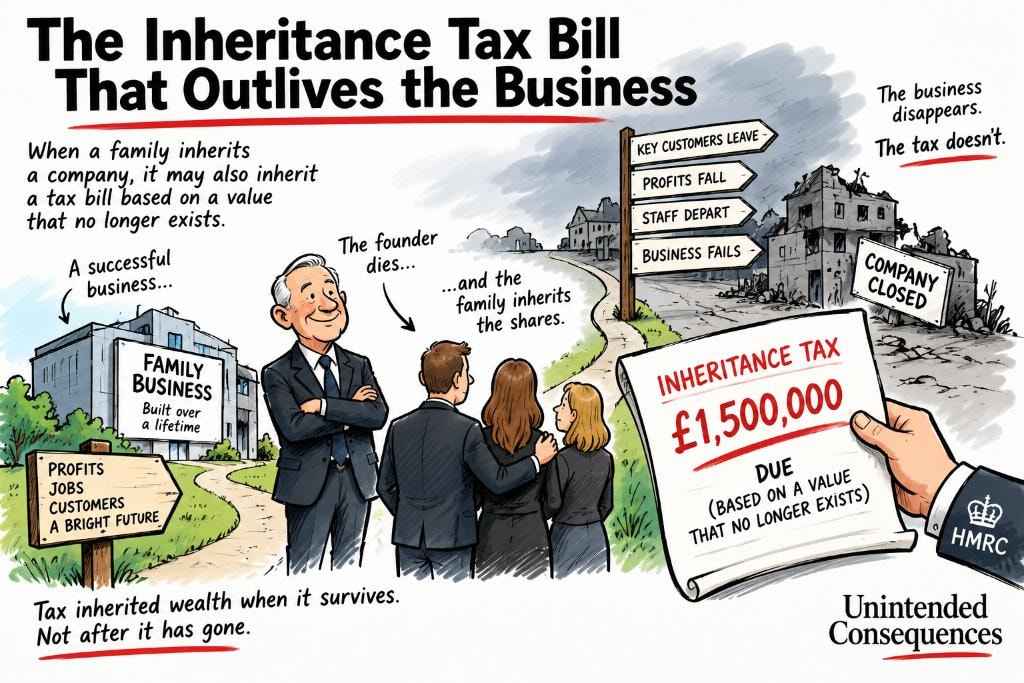
Imagine a founder has spent 35 years building a successful private company worth £10 million.
It employs 60 people and makes £1 million a year. The founder knows the customers, wins the major contracts, understands the market and makes most of the important commercial decisions.
Then he dies.
His children inherit the shares.
On paper, they have inherited a £10 million asset.
In reality, they may have inherited a business that has just lost its most valuable asset: the founder himself.
Customers reconsider their relationships. Senior employees leave. Competitors approach key accounts. Profits fall.
Three years later, the company fails.
Unfortunately, the inheritance tax calculation was made when the shares were worth considerably more.
A Tax on Yesterday's Value
This is where the problem becomes uncomfortable.
Using a deliberately simplified example, take a qualifying business worth £10 million.
The first £2.5 million could receive 100% Business Relief. The remaining £7.5 million receives 50% relief, leaving £3.75 million potentially exposed to inheritance tax before other allowances and exemptions.
At 40%, that could mean a tax liability of £1.5 million.
The government has recognised the liquidity problem to some extent. From April 2026, inheritance tax attributable to qualifying Business Relief property can be paid in ten annual interest-free instalments.
So the family might initially face £150,000 a year rather than finding £1.5 million immediately.
That sounds reasonable until the business starts failing.
The family could find itself paying tax on a £10 million inheritance while watching that £10 million disappear.
And the subsequent collapse of the company does not automatically cause HMRC to recalculate the original inheritance tax bill.
The Valuation Problem
This creates another difficulty.
What was the company actually worth on the day the founder died?
Historic accounts may show £1 million annual profits. An accountant could look at comparable transactions and conclude that similar businesses sell for five or six times earnings.
But would anybody really have paid £6 million for this particular company immediately after the person responsible for much of its success had died?
Perhaps not.
A knowledgeable purchaser would consider the security of customer relationships, management strength, recurring revenues, contracts, intellectual property and the extent to which profits depended upon the deceased founder.
So two perfectly competent valuers could arrive at very different numbers.
Before the 2026 changes, that argument was less important for many qualifying private companies because 100% Business Relief could remove the entire value from inheritance tax. The new £2.5 million limit means that valuations above the allowance can now directly affect the tax payable.
We have therefore created something else as well: a new reason for estates and HMRC to argue about private-company valuations.
And What If the Business Fails?
This is the part that deserves more attention.
Suppose the business genuinely was worth £10 million at the date of death. There was a competent management team and good customers.
Two years later there is a recession, a major customer fails, technology changes the market or several senior employees leave.
The company collapses.
The shares may now be worthless.
But the inheritance tax arose from the value at death.
The family hasn't inherited £10 million in cash. It hasn't necessarily sold anything. It may not even have received substantial dividends.
It inherited an operating business.
The business has disappeared.
The tax hasn't.
That is a fundamentally different proposition from taxing inherited cash, property or readily saleable investments.
The Perverse Incentive
There is another unintended consequence.
A successor facing a substantial inheritance tax liability may have to extract cash from the company to pay it.
But that may be precisely the moment when the company needs cash most.
After the founder's death, the sensible commercial response might be to strengthen management, retain working capital, invest in new salespeople and reassure customers.
Instead, money may have to leave the business to meet inheritance tax instalments.
The tax designed to capture some of the value of the inherited company could therefore contribute to weakening the company that created the value.
Human beings have an impressive ability to design circular problems.
A Fairer Safety Valve
There is an obvious question policymakers should consider.
If qualifying shares in a genuine trading business substantially decline in value or become worthless within, say, five years of the founder's death, should there be a mechanism allowing the inheritance tax attributable to those shares to be reconsidered?
Such a relief would clearly need safeguards. Families could not be allowed deliberately to strip assets, divert customers into another company or engineer a collapse simply to eliminate tax.
But genuine commercial failure is different.
Independent valuations, insolvency practitioners and anti-avoidance rules could distinguish between the two.
The principle would be simple: tax inherited wealth when that wealth survives. Do not leave families paying inheritance tax for years on business value that has genuinely ceased to exist.
The Unintended Consequence
The 2026 Business Relief reforms are intended to raise revenue while protecting smaller family businesses. The first £2.5 million of qualifying property remains capable of receiving full relief, and larger qualifying businesses still receive substantial relief above that threshold.
But larger family companies are not bank accounts.
Their value can depend on people, relationships, knowledge and confidence. The death that triggers the inheritance tax charge may itself destroy some of the value being taxed.
That creates an uncomfortable possibility.
A founder spends a lifetime building a business. His children inherit it and attempt to keep it alive. The business subsequently fails and the family's supposed multimillion-pound inheritance disappears.
Yet the tax bill survives.
The ultimate unintended consequence would be successors losing the family business and then discovering that they still have to pay inheritance tax on the business they no longer have.
About the author
Robert Woodland-Ferrari
Businessman, entrepreneur and lifelong observer of decisions that seemed like a good idea at the time.