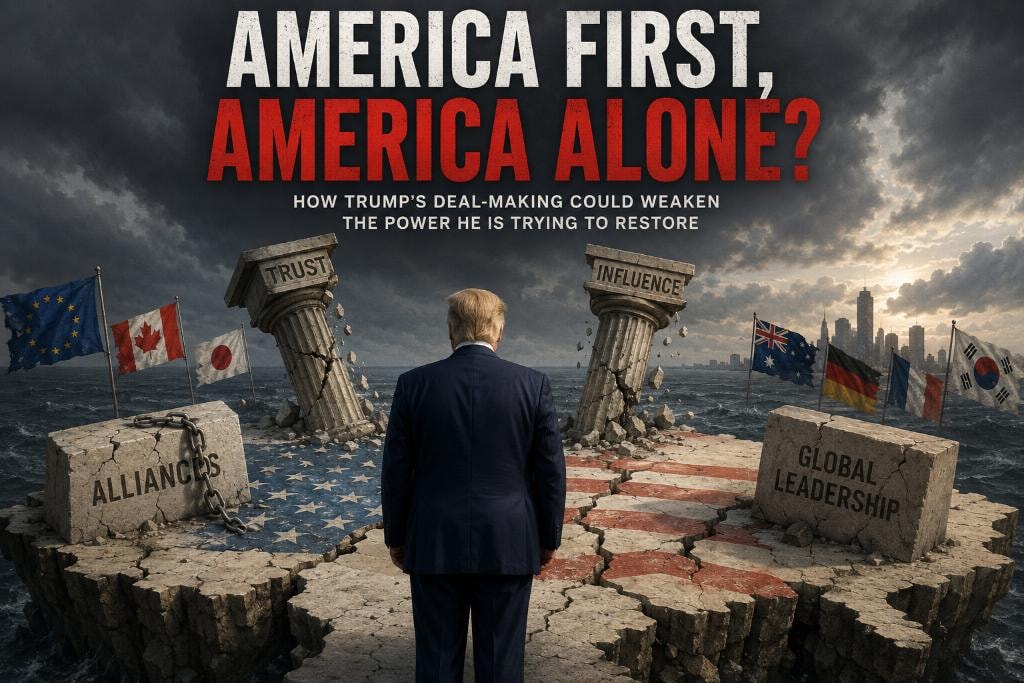
Donald Trump returned to the White House promising to restore American power. Allies would pay their fair share. China would stop exploiting American trade. Manufacturing would return home. Borders would be controlled. Foreign governments would stop taking American protection and markets for granted. Washington would negotiate from strength rather than apologise for possessing it.
There is considerable logic behind parts of that argument.
Europe had become too dependent on American defence spending. China had built enormous industrial capacity while benefiting from access to Western markets. America's trade deficits were persistent. Illegal immigration had become politically and administratively unsustainable. Successive governments had allowed federal borrowing to reach extraordinary levels.
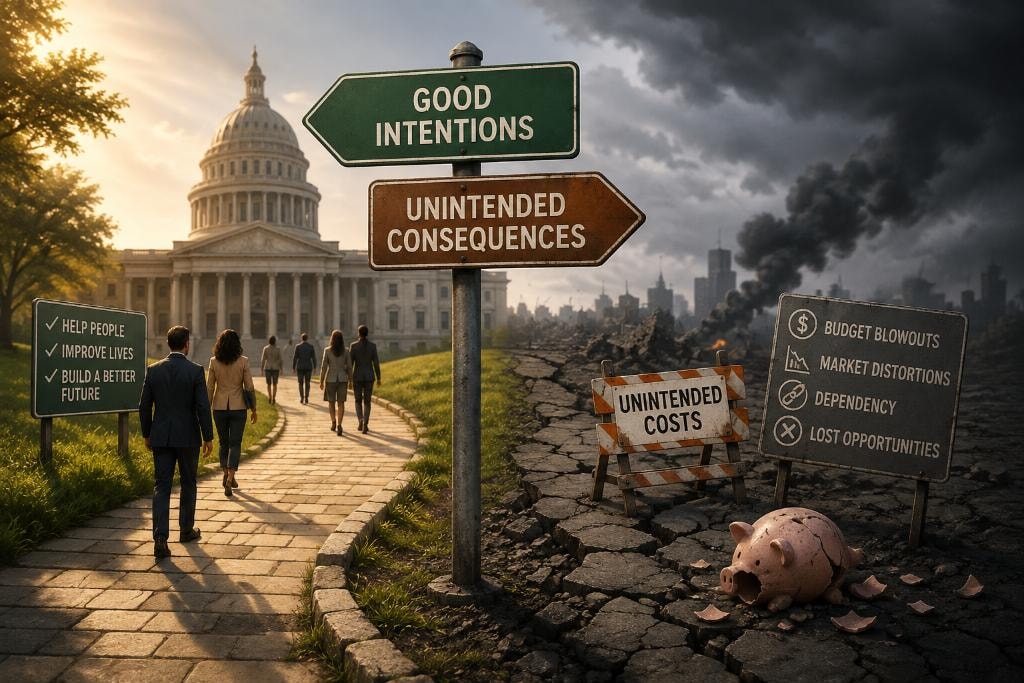
Trump did not invent these problems. But he may be creating another one.
The President's preferred solution is pressure: tariffs, deadlines, threats, demands and deliberately unpredictable negotiating positions. The assumption is that because America possesses enormous economic and military power, other countries ultimately have more to lose from confrontation than the United States.
In individual negotiations, that can work. The unintended consequence emerges when the rest of the world starts responding not to an individual Trump demand, but to the pattern behind them. Countries begin asking a different question: How do we make ourselves less vulnerable to America next time? And that could eventually prove far more important than whether Trump wins any particular negotiation.
The enormous asset America never puts on its balance sheet
For most of the period since 1945, American power has rested on considerably more than aircraft carriers, nuclear weapons and GDP. It has rested on trust. Governments believed American security guarantees. Investors trusted American financial institutions. Central banks accumulated dollars. International companies raised money in American capital markets. Scientists wanted positions at American universities. Students wanted American degrees. Entrepreneurs wanted to build businesses in Silicon Valley. Countries wanted access to American markets. And allies generally believed that although they would periodically disagree with Washington, the United States was fundamentally predictable.
That predictability had enormous economic value. America did not always need to force countries to cooperate. Countries frequently wanted to cooperate with America. That distinction matters.
But international perceptions are changing. A Pew Research Center survey across 36 countries published in June 2026 found predominantly negative views of Trump internationally and substantial deterioration in perceptions of the United States as a reliable partner. In Canada, for example, the proportion describing America as reliable fell from 83% in 2022 to 35% in 2026. Similar large declines appeared across several longstanding European allies. That is not merely an opinion-poll problem. It is potentially the depreciation of a strategic asset.
The Trump doctrine: uncertainty is leverage
Trump's negotiating philosophy is not particularly difficult to understand. Never allow the other side to know exactly what you will do. Demand considerably more than you expect to receive. Establish a deadline. Threaten consequences. Be prepared to escalate. Then negotiate. It is essentially the property developer's negotiating technique applied to international relations. Sometimes it works spectacularly well.
The difficulty is that countries are not property transactions. The people sitting opposite America today will still be there tomorrow. And they learn. If uncertainty becomes America's negotiating weapon, reducing exposure to America becomes everybody else's defence against it. That is where the unintended consequences begin.
NATO: Trump got what America wanted
For years American presidents complained that European members of NATO weren't spending enough on defence. They were right. Europe enjoyed the protection of the world's most powerful military while many European governments allowed their own armed forces to deteriorate. Trump said so rather less diplomatically. He repeatedly questioned why American taxpayers should subsidise wealthy European countries unwilling to spend adequately on their own defence. The criticism had an effect. European defence expenditure has risen substantially. From an America First perspective, that looks like success. And initially it is.
But something else has changed. European governments are no longer discussing defence spending solely in terms of contributing more to NATO. Increasingly they are discussing European strategic autonomy. That is a very different proposition. If Europe concludes that an American security guarantee can vary according to the occupant of the White House, the rational response isn't simply to spend more. It is to become capable of operating without America. Trump therefore risks achieving something American governments have requested for decades while simultaneously producing something they never particularly wanted: a Europe militarily strong enough to become less dependent upon Washington. That is an almost perfect unintended consequence.
Greenland: when allies become negotiating targets
The Greenland dispute illustrates the problem particularly clearly. Trump argued that control of Greenland was important to American national security because of its Arctic location and strategic importance. There is a legitimate geopolitical argument here. The Arctic is becoming increasingly important. Russia has enormous Arctic interests. China has ambitions in the region. Greenland's location and mineral resources matter.
But Trump went considerably further. In January 2026 he threatened additional tariffs against Denmark, Britain, France, Germany, the Netherlands, Norway, Sweden and Finland unless the United States was permitted to acquire Greenland. He subsequently stepped back from those tariff threats.
Consider the message received in European capitals. These aren't American adversaries. They are some of America's closest allies. Tariffs had effectively become a negotiating weapon against NATO members over the territory of another NATO member. Trump saw leverage. Europe saw vulnerability. The distinction matters enormously. Because the rational European response is not necessarily to persuade Trump to behave differently. It is to make Europe less susceptible to the next American president who tries the same technique.
Tariffs: the weapon that encourages people to build armour
The same phenomenon applies to trade. Trump believes America's enormous consumer market gives Washington extraordinary negotiating power. Again, he is correct. Access to American consumers is tremendously valuable. That allows Washington to tell another country: Change your behaviour or lose access to our market. The immediate negotiating power is obvious.
But tariffs create incentives on both sides. American businesses may manufacture domestically — that is the intended consequence. But companies can also raise prices, change suppliers, relocate production elsewhere or redesign supply chains. Foreign governments can retaliate. And countries repeatedly subjected to American tariff threats can seek alternative markets. That is the unintended consequence. America is effectively telling the world: Dependence on the American market represents a political risk. Businesses and governments are perfectly capable of understanding that message. Once they do, diversification becomes prudent.
The world's greatest customer may be encouraging its suppliers to find other customers
This matters particularly in America's confrontation with China. The strategic objective is understandable. Washington wants to reduce Chinese dominance of critical manufacturing and prevent Beijing from exploiting dependence on Chinese supply chains. But imagine the situation from Beijing. China has spent years arguing that the world should become less dependent upon an American-dominated financial and trading system. Then Washington starts threatening tariffs against not merely China but Canada, Europe, Mexico and other allies. China could hardly devise a better advertisement for diversification.
America's allies do not suddenly become Chinese allies. That would be a considerable exaggeration. But they may increasingly pursue a third option: neither dependence on China nor dependence on America. That produces a more fragmented global economy. And fragmentation reduces the exceptional position the United States enjoyed within the old system.
The paradox of American power
There is a deeper principle here. Power works differently depending upon how frequently it has to be used. Imagine two enormously powerful countries. Country A's allies generally cooperate because they trust it. Country B's allies cooperate because they fear economic punishment if they don't. Both may obtain the same result today. But Country B has a problem. It must continuously demonstrate its willingness to punish. Country A possesses influence. Country B increasingly relies upon coercion. Influence is cheap. Coercion is expensive. America's post-war genius was that it possessed both. Trump risks shifting the balance from one towards the other.
America's universities provide another warning
Immigration offers another example of a policy addressing a genuine problem while potentially damaging an unrelated American advantage. The Trump administration has tightened visa rules and enforcement affecting foreign students. New regulations announced in 2026 limit student and exchange visa periods generally to no more than four years, replacing a system under which many students could remain for the duration of their academic programmes. Again, there is an entirely legitimate government objective. A country is entitled to know who is living within its borders and whether visa holders continue to meet their conditions.
But America possesses perhaps the greatest international talent-attraction machine ever created. For decades ambitious young people from India, China, Europe, Latin America and elsewhere have competed to enter American universities. Their home countries frequently paid the considerable cost of raising and educating them. Then, at precisely the point when they became economically valuable, many moved to America. Some became academics. Some became doctors. Some became engineers. Some created companies. Some employed thousands of Americans. It has been an astonishingly successful form of intellectual immigration. America didn't have to steal the world's scientists. They applied voluntarily. Making that process less attractive carries a considerable opportunity cost.
The student who doesn't come to America
The economic loss is also largely invisible. Suppose an exceptionally talented 22-year-old Indian engineering student considers Stanford, Imperial College London, Toronto and Singapore. In the past, America may have been the obvious choice. Now suppose visa uncertainty changes the decision. She goes to Britain instead. Nothing visibly happens in America. No factory closes. Nobody loses a job. There is no government statistic recording: Potential founder of a $10 billion American company decided not to come.
That is precisely why unintended consequences are so easily ignored. The costs often consist of things that never happen. The company never created. The invention never developed. The tax never collected. The employee never hired. Bastiat's unseen consequence remains remarkably relevant nearly two centuries later.
Then there is the dollar
This is where the stakes become considerably larger. The United States possesses an economic privilege unlike that of almost any other country. Much of the world wants dollars. International trade is frequently conducted in dollars. Central banks hold dollars. Investors buy American Treasury securities. Companies borrow dollars. That global demand allows the American government to borrow enormous sums on terms most countries could never sustain.
And enormous is no exaggeration. US federal debt has now passed $40 trillion, having approximately doubled since 2017. Publicly held debt accounts for more than $32 trillion of that total. The Treasury currently expects to borrow another $739 billion during the third quarter of 2026 alone. The crucial issue is not simply the amount of debt. It is the price America must pay investors to hold it. Long-term Treasury yields have risen sharply. Reuters reported this week that investors were demanding the highest yields in many years at recent 10- and 30-year Treasury auctions as concerns increased about inflation, deficits and America's continuing borrowing requirements. There is no evidence that the world is suddenly abandoning Treasury securities. Demand remains substantial. But investors are demanding more compensation. That distinction matters.
Confidence cannot be ordered by executive decree
America's reserve-currency advantage ultimately depends upon something remarkably fragile: confidence. Investors need to believe that American institutions remain credible. They need confidence in the Federal Reserve. They need confidence in Treasury markets. They need confidence in the legal system. And foreign governments need confidence that holding American assets will not unnecessarily expose them to political risk.
Repeated use of financial power creates an obvious incentive for governments to explore alternatives. China wants greater international use of the renminbi. Europe would like a stronger international role for the euro. Other countries are experimenting with bilateral trade arrangements that reduce reliance on dollars. None currently provides a convincing replacement for the dollar. That should not produce complacency. Reserve-currency dominance is unlikely to disappear because somebody invents a superior currency next Tuesday. It can erode gradually. Perhaps over decades. And that would make the consequences particularly difficult for politicians to recognise.
The $40 trillion warning
America's fiscal position makes preserving international confidence even more important. The national debt crossing $40 trillion is not Trump's responsibility alone. That would be politically convenient but historically false. Republican and Democratic administrations both contributed enormously. Pandemic spending under Trump and Biden accelerated borrowing. Tax reductions reduced revenues. Social Security, Medicare and other mandatory expenditure continued growing. Neither political party has demonstrated much appetite for explaining to voters that solving the problem ultimately requires unpleasant choices.
Reuters reports that interest payments have now become the federal government's second-largest expenditure category, exceeding Medicare. That changes the nature of the problem. Higher borrowing produces higher interest costs. Higher interest costs require more borrowing. More borrowing can push yields higher. And higher yields make the next round of borrowing more expensive. The United States therefore has particularly strong reasons to preserve the world's appetite for American debt. Starting unnecessary disputes with the countries and institutions buying it seems an unusual companion strategy.
Trump might still be right about the diagnosis
This is where criticism of Trump frequently becomes too simplistic. Many of the problems he identifies are real. Europe was under-spending on defence. China did exploit weaknesses in the global trading system. America did become dangerously dependent upon foreign manufacturing in strategically important sectors. Illegal immigration does undermine confidence in government. America does need better control over visas. Trade relationships can become unfair. And American governments have sometimes tolerated behaviour from allies because confrontation was diplomatically inconvenient.
Trump's supporters therefore reasonably ask: If previous policy was so successful, why did these problems develop? It is a good question. But identifying a genuine problem does not automatically validate every solution. The proper test of government policy isn't: Did something need to be done? It is: Did this particular action improve matters once all its consequences are included? That second question is considerably harder.
The danger of winning every negotiation
Trump approaches international relations as a series of transactions. America wins. The other party concedes. The President announces the result. The problem is that international power isn't measured solely by the outcome of individual negotiations. Suppose Trump successfully forces European countries to spend more on defence — win. Suppose tariffs persuade several manufacturers to build American factories — win. Suppose immigration restrictions reduce visa overstays — win. Suppose threatening allies produces favourable trade concessions — another win.
But suppose simultaneously: Europe becomes strategically independent. Foreign companies diversify away from America. International students choose other universities. Allies develop alternative defence suppliers. Governments reduce their exposure to US economic pressure. And international confidence in American reliability deteriorates. America could theoretically win the transactions while losing the system. That is the unintended consequence worth watching.
The Chinese advantage
China has its own considerable problems. Its demographic outlook is poor. Its political system can suppress entrepreneurial freedom. Its property sector has experienced enormous difficulties. Its relationships with neighbouring countries are frequently tense. And the renminbi remains nowhere near replacing the dollar as the world's dominant reserve currency. America therefore retains extraordinary advantages.
But strategic competition is relative. China does not necessarily need the world to trust Beijing more than Washington. It merely needs countries to trust Washington less than they once did. A European government that decides it needs independent defence capabilities hasn't become pro-Chinese. A multinational company establishing additional Asian supply chains hasn't become anti-American. A central bank modestly diversifying its reserves hasn't abandoned the dollar. Individually these decisions seem insignificant. Collectively, over twenty years, they could reshape American power.
The insurance-policy effect
Perhaps the simplest way of understanding the phenomenon is insurance. Countries insure themselves against uncertainty. If Russia appears more dangerous, Europe spends more on defence. If China appears more aggressive, Asian countries strengthen military partnerships. And if America appears less predictable, America's allies insure themselves against America.
That doesn't require hostility. Britain can remain an extremely close American ally while simultaneously deciding that greater European defence cooperation is prudent. Canada can remain deeply integrated with the American economy while trying to diversify its exports. European companies can continue investing billions in America while reducing excessive dependence upon the American market. The decisions are individually rational. But collectively they diminish Washington's leverage. And crucially, the process can become self-reinforcing. The more countries diversify, the less leverage America possesses. The less leverage America possesses, the greater the temptation to use what remains more aggressively. Which encourages further diversification.
The ultimate unintended consequence
Trump's political project is explicitly about restoring American greatness. It therefore deserves to be judged against that objective rather than against the intentions of his opponents. The question is not whether Trump makes America more assertive. Clearly he does. The question is whether assertiveness ultimately produces greater American power. Those aren't necessarily the same thing.
For eighty years the United States built an extraordinary international system around itself. Its currency became the world's currency. Its universities attracted the world's brightest students. Its capital markets financed the world's companies. Its military alliances placed American influence across Europe and Asia. Its technology companies became global infrastructure. Its consumer market became the prize exporters everywhere wanted to reach. And remarkably, much of the world participated voluntarily. America's greatest geopolitical achievement may therefore not have been becoming the world's most powerful country. It was constructing a system in which other countries frequently found American leadership preferable to the alternatives.
Trump is testing how much pressure that system can withstand. Perhaps his supporters are right and the result will be a stronger America surrounded by allies who finally contribute properly, companies manufacturing domestically and adversaries who understand that Washington will no longer tolerate exploitation.
But another outcome is possible. Trump may persuade Europe to defend itself. Canada and Mexico to diversify their trade. Foreign manufacturers to reduce their exposure to American policy. Universities and scientists to develop alternative centres of excellence. Central banks gradually to diversify their reserves. And allies everywhere to construct contingency plans for a world in which Washington cannot automatically be relied upon.
If that happens, Trump's greatest unintended consequence will contain a remarkable irony. In demonstrating just how much power America possesses over the rest of the world, he may finally persuade the rest of the world to reduce how much power America possesses over them. And unlike a tariff, that consequence would be extremely difficult for the next president simply to reverse.
About the author
Robert Woodland-Ferrari
Businessman, entrepreneur and lifelong observer of decisions that seemed like a good idea at the time.