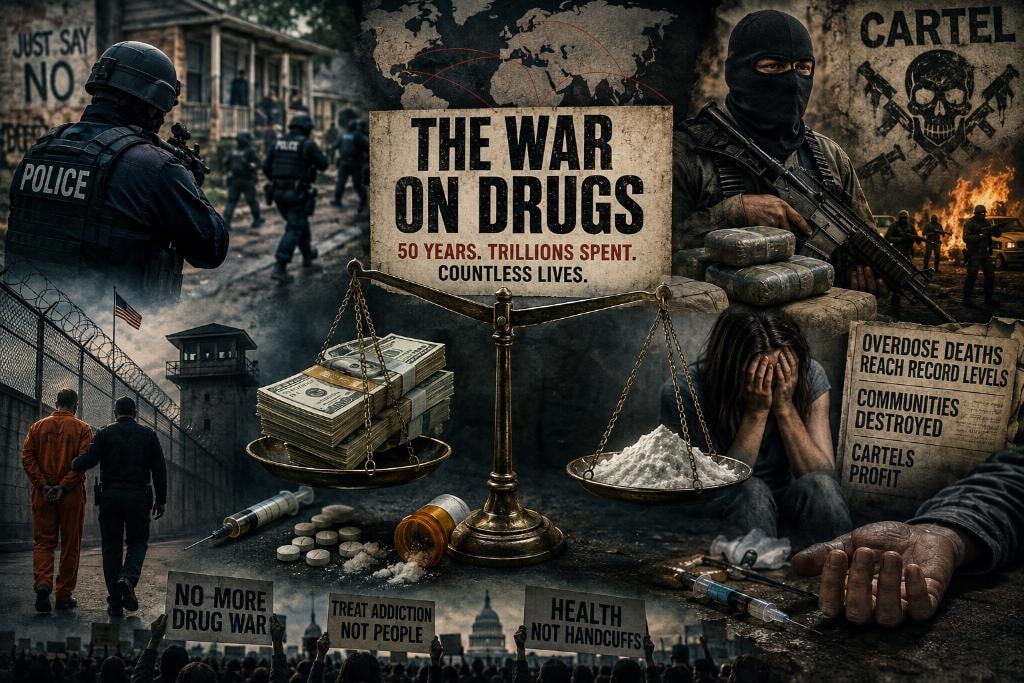
In 1971, US President Richard Nixon declared drug abuse "public enemy number one". The objective was understandable: drugs destroyed lives, addiction damaged families and criminal suppliers profited from human misery. Remove the drugs, punish those supplying them and discourage people from taking them, and society would surely become safer. More than half a century later, however, there is an uncomfortable question: what if the attempt to eliminate drugs actually helped create a far more dangerous drugs industry?
The United States led what became known as the War on Drugs, but this was never merely an American experiment. Britain pursued prohibition and criminal enforcement under the Misuse of Drugs Act 1971, similar policies spread across Europe and much of the world, and enormous resources were directed towards destroying crops, intercepting shipments, arresting dealers and prosecuting users. Yet the global illegal drugs business did not disappear. It industrialised.
The Business Prohibition Created
Illegal drugs are unusual products because governments do not merely regulate their supply; they attempt to prevent legitimate businesses supplying them altogether. Demand, however, does not necessarily disappear because supply has been prohibited, and where demand remains but legal supply disappears, somebody eventually supplies the market illegally.
The extraordinary profitability of the drugs trade therefore comes partly from prohibition itself. A substance that may cost relatively little to produce becomes immensely valuable by the time it reaches consumers because everyone involved in transporting and selling it must be compensated for the risk of arrest, imprisonment, confiscation or death. That premium creates an irresistible commercial opportunity for criminals.
Governments inadvertently created a market in which conventional businesses could not participate but criminals could make fortunes. Small-time smugglers became organised networks, networks became cartels, and cartels acquired weapons, intelligence operations, transport fleets, money-laundering systems and political influence. The state had not abolished the market; it had changed who was allowed to operate it.
Fifty Years of Enforcement and a Bigger Market
The scale of today's illegal drug economy is difficult to reconcile with the idea that prohibition has successfully constrained supply. The United Nations estimated that 316 million people used an illegal drug in 2023, excluding alcohol and tobacco, equivalent to around 6% of the world's population aged 15–64.
Cocaine provides perhaps the clearest illustration. An estimated 17 million people used cocaine worldwide in 2013; by 2023 the figure had reached around 25 million. Global cocaine production reached a record 3,708 tonnes in 2023, approximately 34% higher than just a year earlier, while subsequent UN evidence suggests production and seizures have continued at extraordinary levels.
This is a remarkable outcome after decades of international interdiction. Governments have seized more drugs while criminals have produced more drugs. The War on Drugs has sometimes resembled a business development programme for the people it was intended to destroy.
The Balloon Effect
Drug enforcement suffers from a persistent problem sometimes described as the "balloon effect": squeeze one part of the market and another expands. Destroy coca production in one region and cultivation moves elsewhere; close one trafficking route and another opens; arrest one gang and competitors fight for its territory; seize a shipment and suppliers increase production to compensate for expected losses.
This is one of the fundamental difficulties with supply-side drug policy. A successful police operation can be completely successful as a police operation while accomplishing remarkably little economically. A tonne of cocaine can be seized, fifty dealers imprisoned and a trafficking network dismantled, but if another organisation replaces the supply within weeks, the underlying market has barely changed.
America: From Cocaine to Fentanyl
The United States demonstrates another unintended consequence. When authorities make one drug or supply route more difficult, criminal markets adapt, and that adaptation increasingly favours drugs that are concentrated, easy to conceal and highly profitable to transport.
Synthetic opioids transformed that calculation. Fentanyl can be extraordinarily potent in minute quantities, making it commercially attractive to illegal suppliers but exceptionally dangerous to consumers because dosage becomes difficult to control and users may not even know fentanyl is present.
The result contributed to an American public-health catastrophe. US overdose deaths increased dramatically after 1999, with illegally manufactured fentanyl becoming a major driver of mortality. There has finally been substantial improvement: final US data recorded 79,384 overdose deaths in 2024, with provisional figures indicating another significant fall during 2025.
That is genuinely encouraging, but it is difficult to attribute the improvement simply to tougher prohibition. The American response increasingly includes naloxone distribution, addiction treatment, better surveillance, medications for opioid-use disorder and targeted public-health interventions alongside law enforcement. After decades of treating drugs principally as a criminal problem, some of the most promising results are emerging from treating addiction as a health problem as well.
Britain Fought the Same War
Britain avoided some of the rhetoric of America's War on Drugs but pursued much the same fundamental strategy. Possession was criminalised, dealers imprisoned, customs and police intercepted supply, and successive governments promised to disrupt organised crime and reduce availability. Yet drugs remain widely available.
The Government's own independent review led by Dame Carol Black described a highly profitable drugs market associated with serious violence, organised criminal groups and the exploitation of vulnerable children through county-lines networks. The Government subsequently estimated that drug misuse cost society approximately £19.3 billion every year, with 86% of those costs associated with heroin and crack cocaine.
After decades of prohibition, Britain had therefore not eliminated the market. Instead, it had developed an illegal industry costing society billions while requiring another expensive system of policing, courts and prisons to contain its consequences.
County Lines: An Unintended Distribution Network
Perhaps Britain's clearest unintended consequence is county lines. Urban drug markets became saturated and heavily policed, so criminal organisations responded commercially by expanding into smaller towns and rural communities, frequently recruiting children and vulnerable adults to transport drugs, hold money or provide accommodation.
The terminology sounds almost corporate because economically that is what happened: the market developed regional distribution, except its sales representatives were sometimes vulnerable teenagers. This is what adaptive illegal markets do. Enforcement does not necessarily destroy them; it changes their business model.
Britain Is Still Losing People
The human consequences remain severe. In England and Wales, 5,565 drug-poisoning deaths were registered in 2024, the highest number since records began in 1993, with opiates and opioids involved in almost half. More disturbing still is the emergence of nitazenes, extremely powerful synthetic opioids, with deaths involving them increasing almost fourfold between 2023 and 2024.
Scotland illustrates the problem even more starkly. There were 1,017 drug-misuse deaths registered in 2024. Although this represented a welcome reduction from 2023, the age-adjusted mortality rate remained 3.6 times its level when the statistical series began in 2000. People living in Scotland's most deprived communities were twelve times more likely to die from drug misuse than those in its least deprived areas.
A policy intended to protect society has therefore produced outcomes disproportionately concentrated among precisely the communities government policy is supposed to protect.
The Potency Paradox
There is another consequence of prohibition that appears repeatedly throughout history: prohibition encourages potency. During American alcohol prohibition, smugglers preferred spirits to beer because concentrated alcohol was easier and more profitable to transport. Drug prohibition creates similar incentives.
Cannabis markets develop stronger products, while opioid markets have moved from opium towards heroin and then towards synthetic opioids such as fentanyl and nitazenes. Suppliers naturally maximise the amount of saleable psychoactive substance that can be transported in the smallest possible volume.
This creates what might be called the potency paradox: the harder governments make drugs to transport, the greater the commercial incentive to transport stronger drugs. A policy designed to make drugs less available can therefore encourage the development of more dangerous versions of them.
Violence Comes With the Market
Illegal markets have another distinctive characteristic: they cannot use courts. If two legitimate businesses have a commercial dispute, they can resort to lawyers, courts and contracts. Drug organisations have no comparable mechanism. They cannot sue a supplier for failing to deliver cocaine, obtain an injunction against a rival gang or ask the police to recover stolen inventory, so disputes are instead enforced through intimidation and violence.
This matters because some violence associated with drugs does not arise directly from consuming drugs but from the structure of the illegal market surrounding them. Drugs are prohibited partly because they cause crime; prohibition makes supplying them immensely profitable; those profits attract organised crime; organised criminals use violence to protect their markets; and governments then point to the resulting violence as evidence that stronger enforcement is necessary.
The unintended consequence becomes part of the justification for continuing the policy that helped produce it.
Latin America Paid the Price
The consequences have not been confined to consuming countries. Colombia, Mexico and other Latin American nations have spent decades fighting organisations financed largely by demand from richer countries. Cartels have corrupted police forces, judges and politicians; journalists have been murdered, communities terrorised and governments forced to deploy military resources against organisations capable of replacing leaders almost as quickly as authorities arrest or kill them.
A cartel leader can be captured, but demand remains and billions of dollars remain available, so somebody else takes his place. Increasingly, the violence associated with cocaine trafficking is also spreading beyond Latin America as criminal organisations compete for rapidly expanding European markets.
Portugal Tried Something Different
Portugal took a radically different approach in 2001. It did not legalise drugs, an important distinction often lost in political arguments. Trafficking remained illegal, but possession of small quantities for personal use was decriminalised and dealt with primarily through administrative and health mechanisms rather than ordinary criminal prosecution.
The philosophy changed: the addict became less an enemy of the state and more a person with a medical and social problem, while treatment, harm reduction and reintegration became central. Portugal is not a drug-free paradise and its experience should not be romanticised; drug problems have evolved and policies have required continued investment and adjustment.
What Portugal demonstrated was that there is an enormous difference between legalising the drugs trade and deciding that imprisoning users may be an ineffective way of reducing addiction. Those two propositions are routinely confused.
The False Choice
Drug policy is too often presented as a choice between two extremes: prohibit drugs aggressively or legalise everything. Yet governments regulate dangerous products constantly. Alcohol is legal but regulated, cigarettes are legal but heavily taxed and restricted, prescription medicines are legal but controlled, and gambling is legal but licensed.
Different drugs may require different approaches. Cannabis does not present the same risks as heroin; a recreational cocaine user presents a different problem from someone dependent on street opioids; and a multinational trafficking organisation should not necessarily be treated in the same way as an addicted individual carrying drugs for personal use.
Prohibition, regulation, taxation, education, treatment and enforcement are not mutually exclusive. The real question is which combination produces the least harm.
What Would Success Actually Mean?
Perhaps the greatest policy mistake was failing to define the objective properly. Was success supposed to mean a world without illegal drugs? If so, the policy has failed spectacularly. If the objective was fewer deaths, less addiction, less crime and weaker organised criminal groups, then those outcomes should be the measures by which policy is judged.
Once that becomes the objective, policy becomes more pragmatic. Police resources can concentrate on violent organised crime and exploitation; treatment can target addiction; education and prevention can reduce demand; harm-reduction programmes can prevent deaths; and mental-health, housing and employment services can address some of the circumstances that make destructive drug use more likely.
The Uncomfortable Economic Truth
There is no perfect drug policy. Legalisation carries risks, commercial companies could encourage consumption, taxation could still leave room for black markets, and decriminalisation without adequate treatment could merely reduce penalties without reducing harm. Acknowledging those risks, however, does not rescue prohibition from scrutiny.
The correct comparison is not between prohibition and some imaginary perfect alternative, but between the actual consequences of prohibition and the probable consequences of other approaches.
After more than fifty years we have considerable evidence. Illegal drugs remain widely available, global cocaine production has reached record levels, organised crime has become extraordinarily wealthy, synthetic drugs have become more potent, and thousands continue to die in Britain while tens of thousands die annually in America. Governments continue spending enormous sums fighting an industry whose extraordinary profitability is partly produced by the fact that it is illegal.
The Unintended Consequence
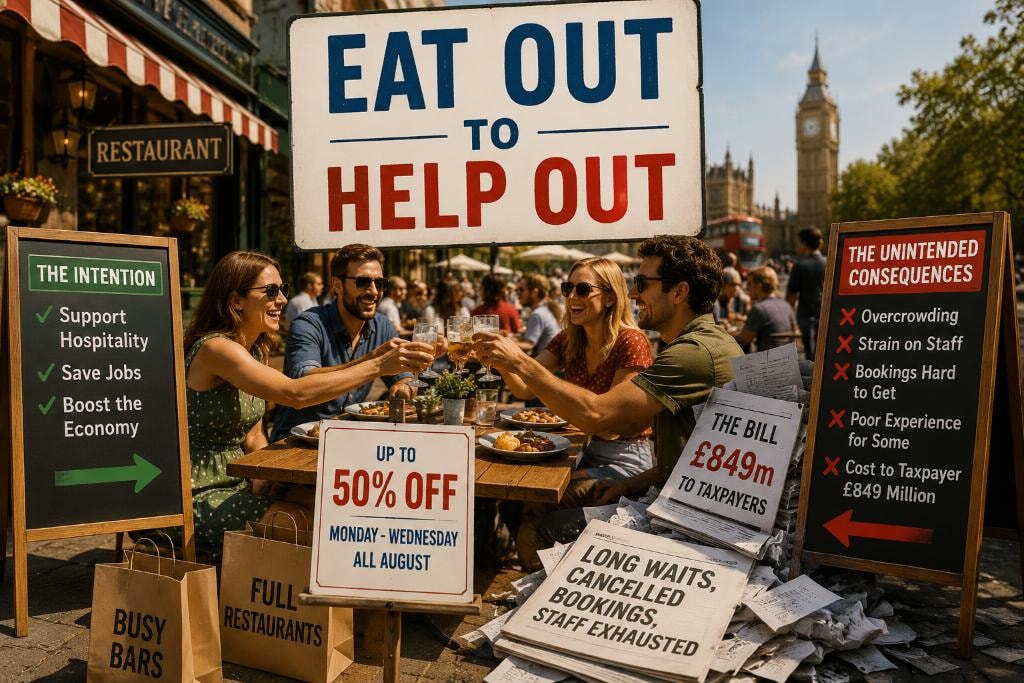
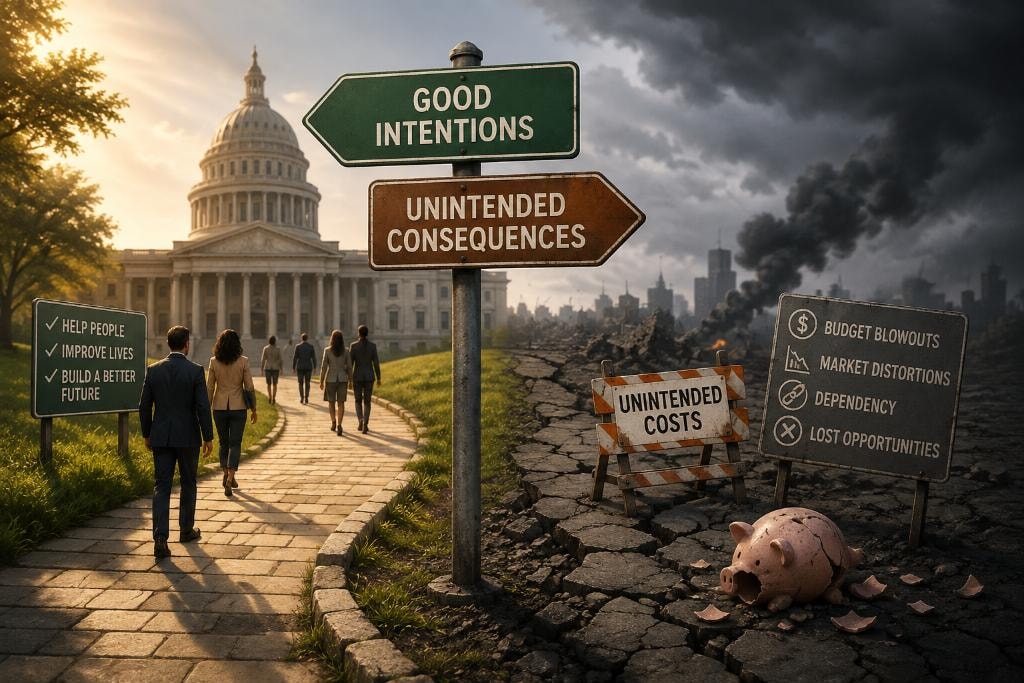
The original intention was admirable: protect people from dangerous drugs. But governments attacked the product without eliminating demand. Scarcity created enormous profits, those profits attracted organised crime, enforcement encouraged traffickers to become more sophisticated, interdiction favoured concentrated substances, arresting dealers created vacancies for new dealers, and criminalising users sometimes pushed vulnerable people further from treatment.
The War on Drugs did not create addiction or humanity's demand for intoxicants, both of which long predate modern government. But it did create an economic environment in which supplying that demand became one of the most profitable criminal enterprises on Earth.
After half a century, perhaps the objective should no longer be to win an unwinnable war against drugs but to minimise the damage drugs cause. That means relentlessly pursuing violent traffickers and those exploiting children while treating addiction principally as a health problem, investing in prevention and treatment, expanding effective harm reduction and being prepared to test regulated alternatives where the evidence supports them.
The distinction is fundamental. Instead of asking "How do we punish drugs out of society?", governments should ask "How do we produce the least harmful society possible given that drugs exist?"
The first question launched a fifty-year war. The second might finally reduce the casualties.
Governments tried to destroy the drugs market by making drugs illegal. Instead, they handed the market to criminals, created enormous profit margins, encouraged increasingly potent products and spent decades fighting organisations financed by the scarcity their own policies created.
Sometimes the most dangerous part of a failed policy is not the failure itself. It is that the consequences of failure become the argument for doing even more of the same.