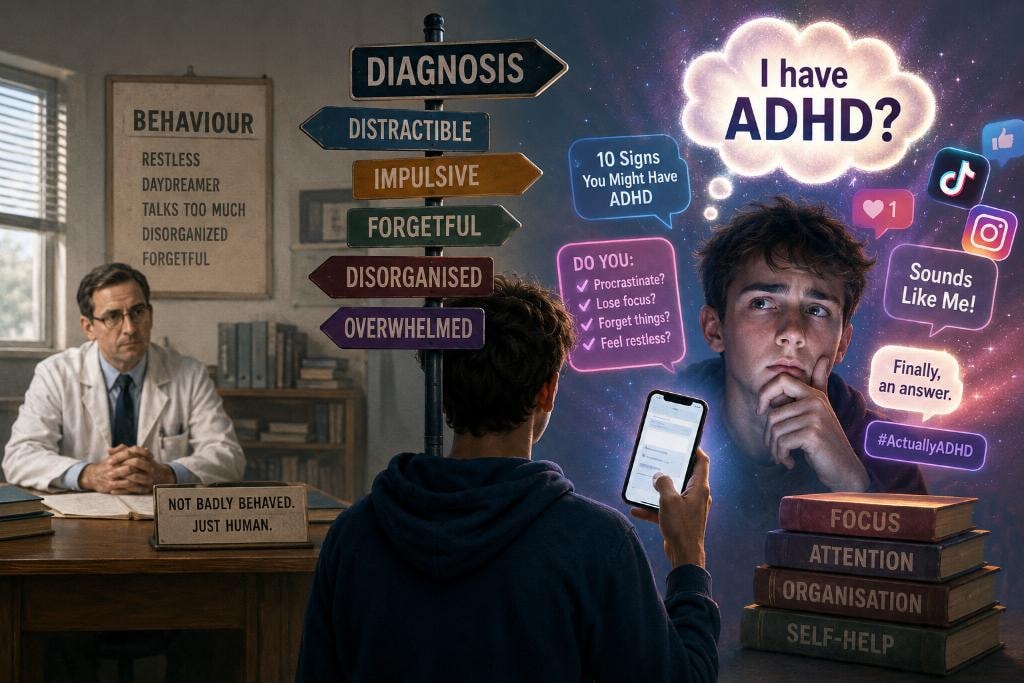
There was a time when a child who couldn't sit still was described as restless. Someone who constantly lost their keys was absent-minded. The colleague who started six jobs and finished three was disorganised. The schoolboy staring out of the window was daydreaming. And the person who became fascinated by something and worked on it obsessively until two in the morning was, depending on the outcome, either eccentric or an entrepreneur.
Today, some of those same behaviours may lead to another possibility: ADHD.
That does not mean ADHD isn't real. It plainly is a recognised disorder, and for people seriously affected by it, diagnosis and treatment can be life-changing. But something rather interesting has happened. We have become extraordinarily good at recognising ADHD. And, as is so often the case with human beings, once we became good at recognising something, we started seeing it everywhere. Welcome to another unintended consequence.
ADHD wasn't suddenly invented
The behaviours associated with Attention-Deficit/Hyperactivity Disorder were described long before the modern acronym appeared. Medical descriptions of extreme inattentiveness, impulsivity and hyperactivity go back well over a century. The terminology changed repeatedly. What eventually became ADHD evolved through various diagnostic categories before arriving at today's definition. So the fashionable claim that ADHD was simply invented recently by pharmaceutical companies doesn't stand up very well. But something else certainly did happen. The definition expanded, awareness exploded and diagnosis increased.
The US Centers for Disease Control and Prevention says there has been an upward trend in estimates of diagnosed childhood ADHD since national surveys began asking parents about it in 1997. Crucially, the CDC also makes a rather important admission: it is not possible to tell whether the increase represents more children having ADHD or more children being diagnosed with it. That distinction is enormous. Because those are two completely different phenomena. One would mean that something is causing more ADHD. The other would mean that society has become much better, or perhaps occasionally rather too enthusiastic, at identifying it. Possibly both are happening.
Seven million American children
In 2022, approximately 7.1 million American children aged 3–17 had at some point received an ADHD diagnosis. That was about 11.4% of children. It was also roughly one million more children than in 2016. That is quite an increase for six years.
But now we get to the really interesting bit. ADHD diagnosis varies enormously depending upon where you live. CDC figures for 2020–23 show current childhood ADHD diagnosis rates including: California 5.6%, Nevada 7.0%, Arizona 8.3%, New York 8.5%, Washington 9.4%, New Hampshire 13.7%, West Virginia 13.8%, South Carolina 14.6%. In other words, an American child can apparently be more than twice as likely to have been diagnosed with ADHD in one state than another.
Human brains presumably don't alter dramatically when families cross a state boundary. So what does? Healthcare systems. Schools. Doctors. Parents. Cultural expectations. Availability of specialists. Attitudes towards medication. Socioeconomic circumstances. Awareness. And perhaps the willingness to interpret certain behaviours as symptoms of a disorder. That doesn't prove overdiagnosis. But it tells us something very important. A diagnosis isn't determined solely by what is happening inside someone's brain. It can also depend upon the society surrounding that brain.
Then came the internet
And here the story becomes even more interesting. For decades, most people encountered psychiatric diagnoses through doctors. Now they encounter them through TikTok, Instagram, YouTube, podcasts and online questionnaires. A person watches a video: 'Ten signs you might have ADHD.' Do you procrastinate? Yes. Do you sometimes find concentrating difficult? Certainly. Do you start projects enthusiastically and lose interest? Frequently. Do you forget why you walked into a room? Obviously. Do you sometimes interrupt people? Apparently. Do you become intensely interested in particular subjects? Yes.
Suddenly the viewer isn't simply an imperfect human being attempting to operate a complicated primate brain in a world containing smartphones, emails, Netflix, notifications and approximately fourteen thousand daily opportunities for distraction. They may conclude: I have ADHD. And once you possess a possible diagnosis, something subtle happens. You begin reviewing your life through it. That unfinished university assignment? ADHD. The forgotten appointment? ADHD. The inability to listen to your partner while simultaneously checking your phone? ADHD. The cupboard containing seventeen unfinished household projects? Definitely ADHD.
A label can provide an explanation. And explanations are comforting. But explanations can also become identities.
Can awareness actually create symptoms?
This is where the question becomes uncomfortable. Can telling people about a condition make them believe they have it? Remarkably, researchers have begun testing exactly that. A recent randomised controlled experiment took healthy young adults and exposed some of them to ADHD awareness information. Beforehand, 28% gave relatively high ratings to the statement that they believed they had ADHD. Immediately after the ADHD awareness session, that figure rose to 58%. The control group barely changed.
Even more interestingly, researchers found that the increased belief in having ADHD occurred without a corresponding change in reported ADHD symptoms. People hadn't suddenly developed ADHD during a workshop. Their interpretation of themselves had changed. Researchers also tested something called nocebo education: explaining beforehand that learning about symptoms can itself cause people to reinterpret normal experiences as evidence of illness. That substantially reduced the effect.
This doesn't prove that today's ADHD epidemic is imaginary. Far from it. But it demonstrates something fascinating about human psychology. Tell people what symptoms to look for and some will find them.
The medicalisation problem
Medicine has performed an extraordinary service by identifying conditions that previous generations misunderstood. Dyslexia wasn't laziness. Depression isn't simply feeling sorry for yourself. Autism isn't bad parenting. And severe ADHD isn't merely a naughty child who needs greater discipline. Recognition has allowed millions of people to receive support instead of criticism. That is progress.
But progress has a recurring problem. Something beneficial at one level can become harmful when extended too far. Once a diagnostic category exists, a boundary has to be drawn between disorder and ordinary variation. And human beings inconveniently refuse to organise themselves into tidy categories. Attention exists on a spectrum. So does impulsiveness. So does memory. So does restlessness. So does motivation. Everyone procrastinates. Everyone becomes distracted. Everyone occasionally becomes overwhelmed.
The medical question isn't simply: 'Do you experience these things?' It is: 'Are they persistent and severe enough to cause significant impairment across important parts of your life?' That is a much higher hurdle. Or at least it is supposed to be.
The diagnosis that explains everything
There is another unintended consequence. Diagnosis can change expectations. Imagine two people repeatedly forgetting appointments. One thinks: 'I'm hopeless at remembering appointments. I need a better diary system.' The other thinks: 'I forget appointments because I have ADHD.' The second explanation may be completely correct. And understanding the cause may allow that person to build better coping strategies. But there is another possibility. The diagnosis becomes an explanation for behaviour and gradually an excuse from changing it.
'I can't concentrate because I have ADHD.' 'I can't organise myself because I have ADHD.' 'I can't finish things because I have ADHD.' The distinction between 'this is more difficult for me' and 'I cannot do this' matters enormously. One encourages adaptation. The other risks encouraging resignation. That isn't an argument against diagnosis. It is an argument against allowing diagnosis to become destiny.
Then there is medication
Once a medical condition is diagnosed, medicine quite reasonably looks for treatments. In the United States, medication has become a major part of ADHD treatment. The CDC notes that the number of FDA-approved ADHD medicines increased considerably from the 1990s onwards, particularly after long-acting formulations appeared. For people with significant ADHD, stimulant medication can produce substantial benefits. But the incentives created by widespread diagnosis shouldn't be ignored. More awareness produces more assessments. More assessments produce more diagnoses. More diagnoses produce more prescriptions. And every stage of that process contains organisations and businesses perfectly capable of expanding to meet demand. Humanity has never needed much encouragement to turn a problem into an industry.
Are we diagnosing ADHD or modern life?
There is another possibility worth considering. Perhaps some of what we are diagnosing isn't simply a change in human brains. Perhaps we have constructed an environment spectacularly hostile to sustained attention. A smartphone can deliver messages, news, email, videos, games, shopping, social approval, political outrage, music, work, gambling, and photographs of what someone you vaguely remember from school had for lunch. All from one device sitting six inches from your hand.
Entire industries employ very clever people whose job is to capture our attention and prevent us directing it elsewhere. Then we express surprise that people have difficulty concentrating. Children encounter screens from infancy. Adults switch constantly between emails, Teams messages, websites and notifications. We have engineered perhaps the most distracting environment in human history. And then, when humans become distracted, we sometimes ask what is wrong with the human. Perhaps occasionally we should inspect the environment.
But underdiagnosis is real too
There is an important danger in pushing this argument too far. The fashionable backlash against ADHD can be every bit as simplistic as the enthusiasm for diagnosing it. Some people genuinely struggled for decades without understanding why ordinary tasks seemed extraordinarily difficult. This has particularly affected adults whose ADHD wasn't recognised during childhood, and women whose symptoms didn't fit the traditional stereotype of the hyperactive schoolboy. For them, diagnosis can produce the opposite effect to becoming ill. It can be liberating. Suddenly decades of difficulty make sense. Treatment may improve work, relationships and daily life.
The unintended consequence would therefore be equally absurd if society swung from 'Everyone has ADHD' to 'Nobody has ADHD.' Reality, irritatingly, tends to live somewhere between slogans.
So has awareness made people ill?
Probably not in the literal sense. Learning about ADHD doesn't suddenly manufacture a neurodevelopmental disorder. But awareness can change how people interpret ordinary experiences. And there is experimental evidence that simply educating healthy people about ADHD symptoms can increase their belief that they have ADHD. That matters. Because once a medical label becomes part of someone's identity, it can influence expectations, behaviour, treatment decisions and perceptions of what they can and cannot do.
The original intention behind greater ADHD awareness was admirable: identify people who were struggling and get them help. The unintended consequence may be that the diagnostic net has become wide enough to catch some people who are simply experiencing the normal frustrations of being human. And perhaps an increasing number who are experiencing something else entirely: being human while carrying a smartphone.
The unintended consequence
For most of history, people adapted themselves to the world around them. Modern medicine has rightly taught us that sometimes the world needs to adapt to people instead. That has been an enormous advance. But there is a danger in travelling too far in either direction. If every difficulty acquires a diagnosis, every personality trait becomes a symptom and every weakness becomes a disorder, we risk turning ordinary human variation into pathology.
The achievement of ADHD recognition was giving an explanation to people whose lives were genuinely impaired by a condition nobody properly understood. Its unintended consequence may be giving the same explanation to people who don't have it. And that leaves us with a wonderfully uncomfortable question. Have millions more people developed ADHD? Have we simply become much better at finding something that was always there? Or, by teaching everyone the symptoms, have we also taught some perfectly healthy people to see themselves as ill? The answer is probably a mixture of all three. Which is considerably less satisfying than a 30-second TikTok diagnosis. But rather more likely to be true.
About the author
Robert Woodland-Ferrari
Businessman, entrepreneur and lifelong observer of decisions that seemed like a good idea at the time.