Economic growth has become one of those political objectives with which nobody disagrees. We need it to improve living standards, fund the NHS, service the national debt, increase wages, and generate the tax revenues required for increasingly expensive public services. The Government has been particularly clear that growth is central to its economic programme. So far, so sensible. Then came the Budgets.
Britain's businesses could reasonably be forgiven for wondering whether the Treasury and the Department for Growth had accidentally attended different meetings. Because if you wanted businesses to invest, employ more people, take risks and expand, increasing the cost of employing people would be a peculiar place to start. Yet that is substantially what happened.
The October 2024 Budget increased employers' National Insurance from 13.8% to 15% from April 2025. More importantly for many employers, the threshold at which employer NI starts was reduced from £9,100 to £5,000. The Government did protect many very small employers by increasing the Employment Allowance from £5,000 to £10,500 — giving qualifying employers a positive incentive to remain small businesses. But for businesses outside that protection, the increase was substantial. At approximately the same time, the National Living Wage increased by 6.7% in April 2025, with another increase following in April 2026.
There is an entirely legitimate social argument for increasing the incomes of lower-paid workers. But there is no economic magic involved. The additional cost has to go somewhere. And that is where the unintended consequences begin.
This is no longer just economic theory. The Bank of England asked businesses how they responded to the increase in employer National Insurance. Across its August to October 2025 surveys: 64% reduced profit margins; 44% reduced employment compared with what it otherwise would have been; 37% increased prices; 17% paid lower wages than they otherwise would have done. Businesses could select more than one response. The National Living Wage increases produced similar effects — reduced margins, higher prices, lower employment. The Bank of England itself concluded that higher employment costs had contributed to weakness in employment growth. So this isn't someone predicting what might happen. It is businesses telling the Bank of England what did happen.
Much political discussion treats profit as though it were a large pot of money sitting in the corner of every company waiting for someone to find a socially useful purpose for it. That might occasionally describe a multinational corporation. It does not describe much of British business. There are roughly 5.7 million private-sector businesses in Britain, and more than 99% are small businesses operating on modest margins. Consider a company with £2 million turnover and £100,000 annual profit. It is unquestionably profitable — but its margin is only 5%. Increase its annual employment costs by £60,000 and the company is still technically profitable. Its profit has simply fallen from £100,000 to £40,000.
Politically this can be described as: 'The business absorbed the additional cost through profits.' But what exactly was that £60,000 going to do before it was absorbed? Perhaps it was going towards new machinery. Perhaps it would have funded another employee. Perhaps it was going into software or AI. Perhaps it was the deposit on larger premises. Perhaps it was simply the cash reserve allowing the company to survive when three customers inexplicably decide that paying invoices on time is an optional extra. For a small business, profit isn't simply the owner's reward. It is often the company's principal source of investment capital — and take enough of it away and something doesn't happen. Quite frequently, the thing that doesn't happen is growth.
Governments don't generate most sustainable economic growth themselves. People do. Someone starts a business. Someone opens another restaurant. Someone develops a piece of software. Someone employs their tenth member of staff. Someone puts £250,000 into an idea that might fail. This tends to get forgotten when economic growth is discussed as an abstract percentage produced by Whitehall. Behind almost every percentage point are thousands of individual decisions about whether investing another pound is worth the risk.
A founder might work sixty hours a week while paying themselves less than they could earn working for someone else. They leave profits inside the business. They delay buying the new car. They guarantee the bank loan. They employ someone before they're entirely certain the revenue will support them. They invest £50,000 today because they believe it will produce £100,000 tomorrow. In other words: they sacrifice some consumption today to create productive capacity tomorrow. Curiously, that is exactly what a country pursuing growth needs to do. Investment today creates productive capacity tomorrow. Productive capacity increases productivity. Higher productivity permits higher wages and profits. Those generate higher tax revenues. And those revenues finance better public services. The difficulty is that the first stage involves sacrifice.
Consider two countries with identical resources. Country A spends almost everything improving current consumption. Country B directs substantially more towards housing, infrastructure, energy, technology, skills and productive investment. Initially, Country A might feel better — it has more money available to spend today. Country B is effectively saying: 'Wait. We're building something.' Ten or twenty years later the picture can look very different. Country B has more houses, better infrastructure, cheaper energy, more productive companies, higher wages, higher profits and a considerably larger tax base. This is not an argument for indiscriminate austerity. It is an argument for distinguishing between consumption and investment. A competent business owner does this instinctively. Government should too.
Take an economy worth £3 trillion. If it grows by 1% a year in real terms, after twenty years it is approximately £3.66 trillion. At 2% annual growth: £4.46 trillion. That is roughly £800 billion of additional annual economic output — in real terms, with inflation stripped out. At a tax burden approaching 40% of GDP, the difference in potential government revenues eventually becomes enormous. That is why raising another £5 billion of tax today while damaging long-term growth can be a terrible bargain. The valuable asset isn't merely today's tax receipt. It is tomorrow's larger tax base.
Britain has not collapsed. The economy has recently shown greater resilience than some forecasts suggested. But the medium-term picture remains unimpressive. The OBR's March 2026 forecast expected real GDP growth of only 1.1% in 2026 and 1.6% in 2027. That is growth — but it is nowhere near the sort of sustained productivity-driven expansion required to transform Britain's public finances or living standards. And this raises the obvious question: if the consequences were predictable, why did the Government do it?
It is tempting to answer: 'Because politicians don't understand business.' There may occasionally be something in that, but it is too simplistic. The more interesting answer is that governments face incentives that encourage precisely this behaviour. First, they inherited a serious fiscal problem. Government expenditure was already extremely high. The NHS required more money, local authorities were struggling, defence spending needed to increase, debt interest was consuming enormous resources. There was therefore a genuine need either to reduce expenditure, increase taxation or borrow more. None was politically attractive, so the Government chose substantial tax increases. That decision can be defended. The more important question is whether the taxes chosen were compatible with the Government's other objective of increasing growth.
Second: taxing employers is politically easier than taxing employees. Increase Income Tax and millions of people immediately see the deduction on their payslip. Increase employer National Insurance and the tax appears to be paid by someone else — 'Business.' Politically, this is enormously convenient. Economically, the distinction is considerably less clear. The Bank of England's evidence shows where businesses found the money: profits, prices, employment and wages. So although the tax is legally paid by the employer, the economic cost ultimately spreads across shareholders, workers and consumers. The tax didn't disappear. It merely became less visible.
Third: the Treasury values certainty. The Treasury can calculate reasonably accurately how much an increase in National Insurance will raise next year. Growth is different. Suppose government allows a business to retain £100,000. The business might invest it. That investment might increase productivity. The company might subsequently employ another five people. Those employees might pay additional Income Tax. All perfectly plausible — but uncertain. Compare that with: 'Increase this tax rate and we collect £X billion next year.' One fits beautifully into a spreadsheet. The other requires faith in human behaviour over perhaps ten years. Government therefore has a natural institutional preference for certain revenue today over uncertain growth tomorrow. A growth company run according to that philosophy would soon cease being a growth company.
Fourth: the electoral timetable is too short. Infrastructure might take ten years to produce its full economic return. Education and skills investment can take even longer. Business investment compounds over decades. Governments face elections roughly every five years. A Chancellor can endure all the political pain of investment while a future government receives much of the benefit. Meanwhile, money spent on immediate consumption produces an immediate political constituency grateful for receiving it. This creates a structural conflict between long-term economic policy and short-term political reward.
Fifth — and this may be the most important unintended consequence of all — each cost looks manageable in isolation. Consider the conversation inside government. Can businesses afford slightly higher employer NI? Probably. Can they afford the National Living Wage increase? Probably. Business rates? Probably. Additional employment regulation? Probably. Pension costs? Probably. Higher energy costs? Probably. Additional compliance? Probably. But businesses don't receive these policies individually. They receive the total bill. And that changes the question completely. The relevant question isn't: 'Can a business absorb this particular increase?' It is: 'After everything else we have already increased, how much money does this business have left to invest?' That is the question that matters for growth.
To be fair, some Government policies genuinely could increase growth. Planning reform is potentially extremely important — Britain's planning system has constrained housing, infrastructure and commercial development for decades. Higher public investment can also increase private investment where it improves transport, energy and other infrastructure. So it would be unfair to suggest the Government has no growth strategy. It does. The problem is one of internal contradiction. One part of policy is trying to increase Britain's productive capacity. Another is increasing the cost of the businesses expected to use that capacity. One foot is pressing the accelerator while the other appears reluctant to leave the brake pedal alone.
Perhaps the objective shouldn't simply be: 'Cut business taxes.' That is too crude. A better objective would be: make it cheaper to grow. If government wants investment, reward investment. If it wants employment, reduce the incremental cost of employing someone. If it wants productivity, make automation and technology investment extraordinarily attractive. An owner extracts £100,000? Tax it normally. The company reinvests £100,000 in productive assets? Give it exceptionally favourable treatment. A company maintains its existing workforce? Normal employer NI. It employs five additional people? Consider temporary NI relief on the additional jobs. The Government then isn't simply handing businesses money and hoping something useful happens. It is explicitly rewarding the behaviour that creates growth.
The founder accepts lower income today because they believe the business will be worth more tomorrow. Britain faces a similar choice. We can maximise government revenue today. Or we can deliberately leave more resources in productive parts of the economy where there is good evidence they will generate investment. That doesn't mean every tax cut pays for itself — it doesn't. Nor does it mean business should be exempt from taxation or regulation — it shouldn't. It means recognising that capital left inside a growing business can itself be an investment in Britain's future tax base. There is inevitably a point at which extracting another pound today costs the Exchequer considerably more than a pound tomorrow. Finding that point should be central to economic policy.
The Government is right about one thing above almost everything else: Britain needs growth. Without sustained productivity growth, politics becomes an increasingly unpleasant argument over how to divide an economy that isn't becoming sufficiently larger. The NHS competes with defence. Pensioners compete with workers. Taxpayers compete with welfare spending. Government competes with businesses for capital. And every Budget becomes another desperate search for a pocket containing money. Growth changes the arithmetic. But growth doesn't occur because a Chancellor announces it. Somebody eventually must invest. Somebody must employ another person. Somebody must risk their savings. Somebody must decide that Britain is a better place to invest £1 million than America, France, Germany or Singapore.
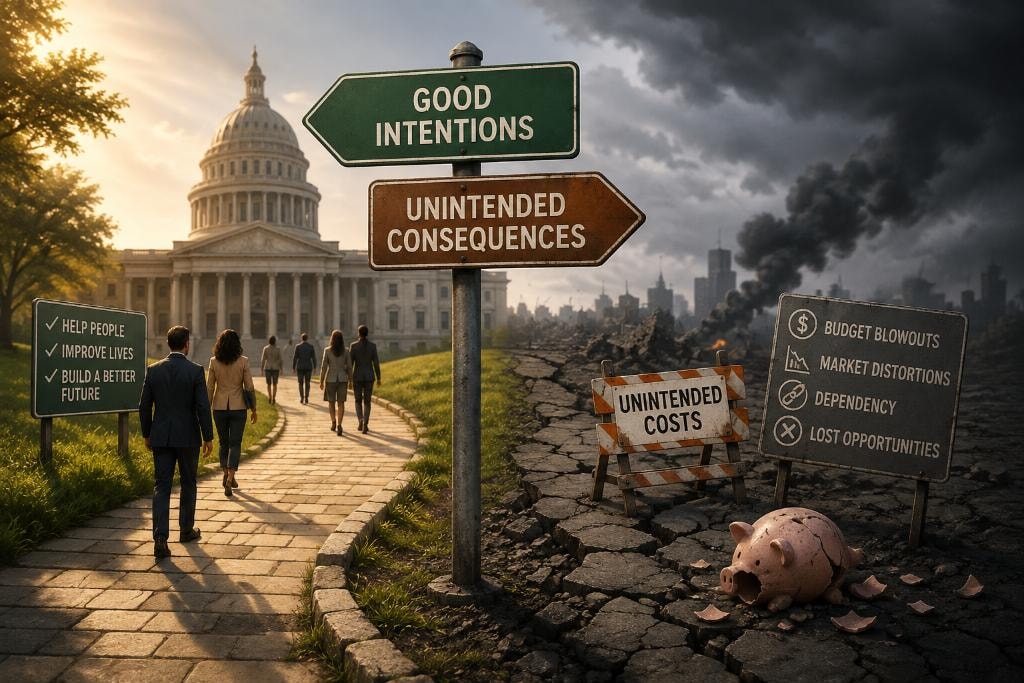
Government says: grow, invest, employ, increase productivity. Then it increases the cost of employing people and takes a historically large share of the economy in taxation. Every individual decision can be explained. The fiscal pressures are real. The NHS genuinely needs money. Workers genuinely need reasonable wages. Public services genuinely need funding. But intentions aren't economic outcomes. Consequences are. Perhaps every future Budget should therefore contain one additional calculation — not simply 'How much money will this measure raise?' but: 'After everything announced today, have we made it more or less attractive to invest the next £100,000 in a British business?' If the answer is more, we may have a genuine growth strategy. If the answer is less, we shouldn't be surprised when investment, employment and productivity disappoint.
And if the Government knew growth was the objective, knew businesses were responsible for creating much of it, and then knowingly increased the cost of those businesses creating it — we are moving into rather interesting territory. Because eventually an unintended consequence that is sufficiently predictable stops being entirely unintended. It becomes a choice.
About the author
Robert Woodland-Ferrari
Businessman, entrepreneur and lifelong observer of decisions that seemed like a good idea at the time.