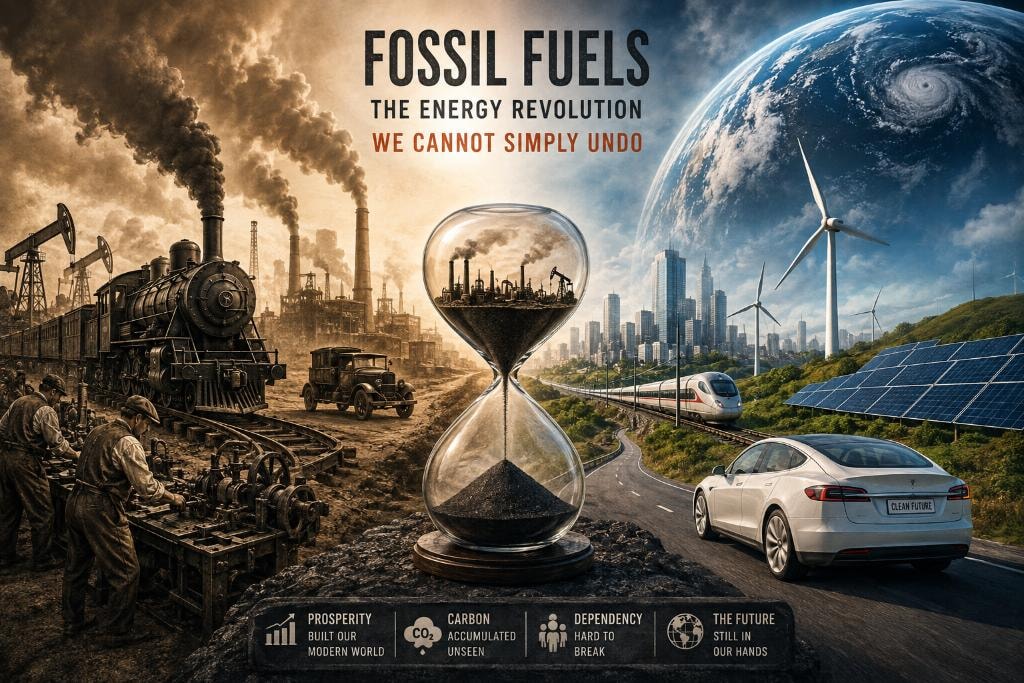
For most of human history, energy was scarce.
Human beings worked with their muscles, animals pulled carts and ploughs, wood provided heat, wind moved sailing ships and water turned mills. Economic growth was constrained by how much energy could be extracted from the immediate environment.
Then we discovered something rather extraordinary.
Beneath our feet lay hundreds of millions of years of stored solar energy in the form of coal, oil and natural gas.
We learned how to burn it.
And almost everything changed.
The Industrial Revolution accelerated. Steam engines powered factories and railways. Coal produced iron and steel on an unprecedented scale. Oil eventually powered cars, trucks, ships and aircraft. Natural gas heated homes and became an important source of electricity and industrial energy.
Fossil fuels did not merely make energy cheaper.
They helped create the modern world.
That is important, because any serious discussion about fossil fuels has to begin with an uncomfortable fact: they have been enormously beneficial to humanity.
The unintended consequence is that the same energy system that helped produce extraordinary improvements in human prosperity also produced environmental costs that accumulate over decades and centuries.
And by the time we properly understood those costs, we had built almost everything around the fuels causing them.
The Original Intention
There was never a meeting at which Victorian industrialists decided: let us burn coal so that we can alter the Earth's climate in 150 years.
The objective was considerably simpler: produce more, transport goods faster, heat homes, generate electricity, build machines, reduce the cost of manufacturing, increase living standards.
Fossil fuels were astonishingly good at doing all of these things.
Coal helped Britain become the world's first industrial economy. Oil transformed transport. Natural gas provided relatively convenient heating and electricity.
Energy became available on a scale previous generations could scarcely have imagined.
The relationship between access to modern energy and economic development remains striking. Electricity enables refrigeration, communications, hospitals, factories, water treatment, education and countless technologies we now regard as ordinary.
The historical achievement should not be rewritten merely because we now understand its consequences.
Fossil fuels were not an irrational choice. For much of their history, they were the best energy source humanity possessed for achieving what humanity desperately wanted: prosperity.
What Happened Next
Success created dependency. Factories were designed around fossil energy. Cities developed around motor vehicles. International trade became dependent upon diesel-powered ships and trucks. Commercial aviation became routine. Agriculture mechanised. Petrochemicals became the foundation of plastics, fertilisers, pharmaceuticals and thousands of industrial products. Homes were fitted with gas boilers. Electricity grids were built around coal and gas generation.
The modern economy became an enormous interconnected machine whose fundamental input was cheap, concentrated energy.
Today, despite decades of investment in alternatives, fossil fuels still provide around four-fifths of global primary energy.
That tells us something important. Replacing fossil fuels is not remotely comparable to replacing one brand of technology with another. We are attempting to replace much of the energy foundation upon which industrial civilisation was constructed.
The Consequence Nobody Paid For
Burning coal, oil and gas releases carbon dioxide. The individual transaction appears harmless. Drive a car ten miles and nothing obvious happens to the climate. Heat a house for an evening and nothing visible changes. Fly from London to New York and the sky still looks much the same when you arrive.
But multiply those actions across billions of people, millions of businesses and many decades and the picture changes completely. Carbon dioxide accumulates in the atmosphere. The costs are therefore separated from the benefits.
The person consuming the energy receives an immediate benefit. The environmental consequences are distributed across the planet and into the future.
Economists have a wonderfully bloodless expression for this: an externality. It means that part of the true cost of an activity is being paid by somebody other than the person benefiting from it.
For much of the fossil-fuel age, the price of coal, petrol or gas reflected the cost of extracting, refining and delivering the fuel. It did not fully reflect the long-term cost of putting its carbon into the atmosphere. The world therefore consumed fossil fuels at a price that did not incorporate all of their consequences. And naturally, being human, we consumed enormous quantities of them.
But Didn't We Know?
Increasingly, yes. The greenhouse effect itself is not a recent discovery. Scientists were investigating the relationship between atmospheric gases and temperature in the nineteenth century. During the twentieth century the science became progressively stronger. By the latter decades of the century, climate change was no longer an obscure theoretical possibility.
Governments knew. Scientists knew. Parts of the energy industry knew. Research subsequently showed that Exxon scientists produced surprisingly accurate projections of global warming decades ago.
Yet fossil-fuel consumption continued rising.
Because knowing that something will eventually create a problem is very different from being willing to surrender its immediate benefits. That is one of the recurring themes of unintended consequences. The future rarely has a powerful lobby. The present does.
Consumers wanted inexpensive petrol. Businesses wanted inexpensive energy. Governments wanted economic growth. Oil-producing countries wanted revenues. Developing countries wanted industrialisation. Politicians wanted re-election.
Everyone could agree that climate change was a serious long-term problem while simultaneously having a perfectly rational short-term reason for continuing to burn fossil fuels. Collectively irrational behaviour can be built from millions of individually rational decisions.
The Developing-World Dilemma
There is another complication often missing from the argument. Hundreds of millions of people still lack adequate access to modern energy.
For someone living comfortably in Britain, abandoning fossil fuels can sound primarily like an environmental decision. For someone living without reliable electricity, energy represents something more fundamental: refrigeration, lighting, clean water, transport, industrial employment, air conditioning, modern healthcare, communications, economic development.
Rich countries became rich while consuming enormous quantities of fossil fuels. Telling poorer countries that they must now develop without following the same path presents an obvious political and moral difficulty.
The objective therefore cannot simply be: use less energy. For much of humanity, the desirable outcome is precisely the opposite. They need more. The real challenge is: how do we provide vastly more energy while producing vastly less carbon? That is a much harder problem.
The Second Unintended Consequence
Attempts to solve the first problem can create another. Governments naturally want to accelerate the transition away from fossil fuels. But if environmental policy raises energy prices too quickly, restricts supply before alternatives exist, or makes domestic industry internationally uncompetitive, political resistance follows.
Factories can relocate. Consumers face higher bills. Energy-intensive industries struggle. Countries become dependent upon imported energy or imported manufactured goods. And voters begin to associate environmental policy with declining living standards.
This is dangerous because a climate strategy that loses public support may ultimately achieve less than a slower but economically sustainable transition.
There is an additional irony. If Britain closes a carbon-intensive factory but subsequently imports the same product from a country using dirtier energy, Britain's territorial emissions may fall while global emissions fall by much less, or potentially not at all. The spreadsheet looks greener. The atmosphere, stubbornly refusing to recognise national borders, remains unimpressed.
Technology Changes the Equation
There is, however, an important difference between today's energy debate and that of thirty years ago. Alternatives are becoming increasingly viable. Solar and wind generation have expanded dramatically. Battery technology is improving. Electric vehicles are becoming mainstream. Nuclear power remains capable of producing large quantities of low-carbon electricity. Heat pumps can replace some fossil-fuel heating. Grid storage, carbon capture, advanced nuclear technologies, hydrogen and synthetic fuels may all play roles.
This changes the nature of the problem. The question is no longer whether humanity must choose permanently between poverty and fossil fuels. The challenge is making clean energy sufficiently cheap, reliable and abundant that consumers and businesses adopt it because it is better, not merely because governments force them to.
That distinction matters enormously. History suggests that technologies spread fastest when they improve people's lives. Nobody needed legislation forcing households to abandon candles for electric lighting. Nobody required subsidies to persuade businesses to use computers rather than typewriters. Superior technologies usually destroy their predecessors remarkably efficiently.
The ultimate victory for clean energy will therefore come when the economic argument and the environmental argument become the same argument.
Cheap Energy Is Not the Enemy
One of the mistakes environmental policy can make is treating energy consumption itself as morally suspect. Energy is prosperity. Cheap, abundant energy allows societies to manufacture more, travel further, heat homes, cool buildings, desalinate water, automate unpleasant work, produce food and develop new technologies.
The objective should not be an energy-poor civilisation with lower emissions. It should be an energy-rich civilisation with lower emissions.
That means the transition should concentrate relentlessly on making low-carbon energy cheaper, more dependable and easier to deploy. Renewables will be part of that answer. So will storage and better electricity grids. Nuclear power deserves serious consideration wherever it can be economically deployed. Natural gas may remain a transitional fuel in some economies. Carbon capture may prove valuable for industries where emissions are particularly difficult to eliminate. And technologies that have not yet reached commercial maturity may ultimately matter more than today's political favourites.
Governments have a notoriously mixed record when attempting to predict technological winners decades in advance.
The Real Unintended Consequence
The fossil-fuel story is sometimes presented as a morality play. Greedy companies discovered dangerous fuels, governments ignored scientists, consumers behaved selfishly and the planet suffered. There are elements of truth in that account. But it is incomplete.
The deeper lesson is more interesting. Humanity discovered an extraordinarily powerful source of energy. We used it to escape many of the constraints that had defined human existence for thousands of years. We built cities, industries, transport systems and living standards around it. And only gradually did we understand that the environmental capacity to absorb the consequences was limited.
By then, dependence was enormous. The problem was not simply that fossil fuels were harmful. The problem was that they were useful beyond imagination. Their success created the dependency that now makes replacing them so difficult.
Could We Have Done Things Differently?
Possibly. Governments could have responded earlier to climate science. Nuclear power might have been developed more aggressively. Carbon pricing could have been introduced sooner. Investment in renewable energy, storage and grid infrastructure could have begun decades earlier. Energy efficiency could have improved faster. The fossil-fuel industry could have acknowledged climate risks more openly rather than, in some cases, resisting policies that threatened its commercial interests.
But hindsight enjoys the considerable advantage of knowing what happened. The real test is not whether previous generations failed to build today's energy system with tomorrow's knowledge. It is whether we continue making the same mistake now that the consequences are understood.
The Lesson
The lesson of fossil fuels is not that industrialisation was a mistake. Nor is it that economic growth should stop. Billions of people still aspire to the living standards already enjoyed by richer countries, and they are entirely entitled to do so.
The lesson is that transformational technologies often produce consequences far beyond the problem they were originally designed to solve. Coal solved the problem of limited mechanical power. Oil solved the problem of mobile energy. Natural gas helped solve heating and electricity generation. Together they helped create unprecedented prosperity. But they also altered the chemistry of the atmosphere.
Now humanity faces another enormous technological transition. And we should remember the lesson. The technologies we choose to solve climate change will themselves have consequences. Vast renewable systems require land and minerals. Batteries require mining. Nuclear energy creates waste and political concerns. Electricity grids require enormous investment. Carbon taxes alter economic behaviour. Energy security changes geopolitical relationships.
There is no consequence-free energy system. The intelligent question is therefore not: which solution has no disadvantages? There isn't one. It is: which combination gives humanity abundant, affordable and reliable energy while creating consequences we can actually live with? That is a much less satisfying slogan. It may also be the right question.
The Unintended Consequence
What we wanted: cheap, abundant energy capable of powering industrialisation, transport, electricity and rising living standards.
What we got: perhaps the greatest expansion of material prosperity in human history.
What we didn't anticipate: a global economy so dependent upon fossil fuels that their cumulative environmental effects became extraordinarily difficult to escape.
The lesson: the greatest unintended consequences often come not from ideas that fail, but from ideas that succeed beyond anything their creators imagined.
About the author
Robert Woodland-Ferrari
Businessman, entrepreneur and lifelong observer of decisions that seemed like a good idea at the time.