Governments are forever promising growth. They promise to increase productivity, encourage investment, liberate entrepreneurs, cut red tape and make Britain competitive again. Then, in September 2022, Liz Truss's government tried something unusual. It actually attempted to do some of those things. The result was one of the most spectacular political and economic implosions in modern British history.
Within weeks, the Chancellor was gone. Shortly afterwards, so was the Prime Minister. Most of the tax cuts were reversed. Government borrowing costs had surged, the pound had fallen sharply and the Bank of England had been forced to intervene in the gilt market after turmoil threatened parts of the pension system.
The episode has since acquired a wonderfully simple explanation: Liz Truss cut taxes. The markets panicked. Therefore tax cuts don't work. Unfortunately, reality is rarely so obliging. The more interesting story is not that Truss wanted growth — Britain unquestionably needed growth. Nor were all the policies inherently foolish. The real unintended consequence was that a government attempting to demonstrate economic radicalism accidentally demonstrated something much more important: you can challenge economic orthodoxy. You cannot ignore the people lending you the money.
Britain Had a Genuine Problem. When Liz Truss became Prime Minister in September 2022, the British economy was hardly a picture of rude health. Productivity growth had been weak for years. Business investment was disappointing. Economic growth was sluggish. Taxes were heading towards historically high levels and the country was simultaneously dealing with the economic after-effects of Covid and an enormous energy shock following Russia's invasion of Ukraine. Inflation was heading towards 11%. Truss's diagnosis was straightforward: Britain had become too comfortable with managing economic decline rather than trying to escape it. Her answer was supply-side economics — reduce taxes, encourage investment, make work more rewarding, remove regulatory obstacles, get businesses expanding, and aim for 2.5% annual economic growth.
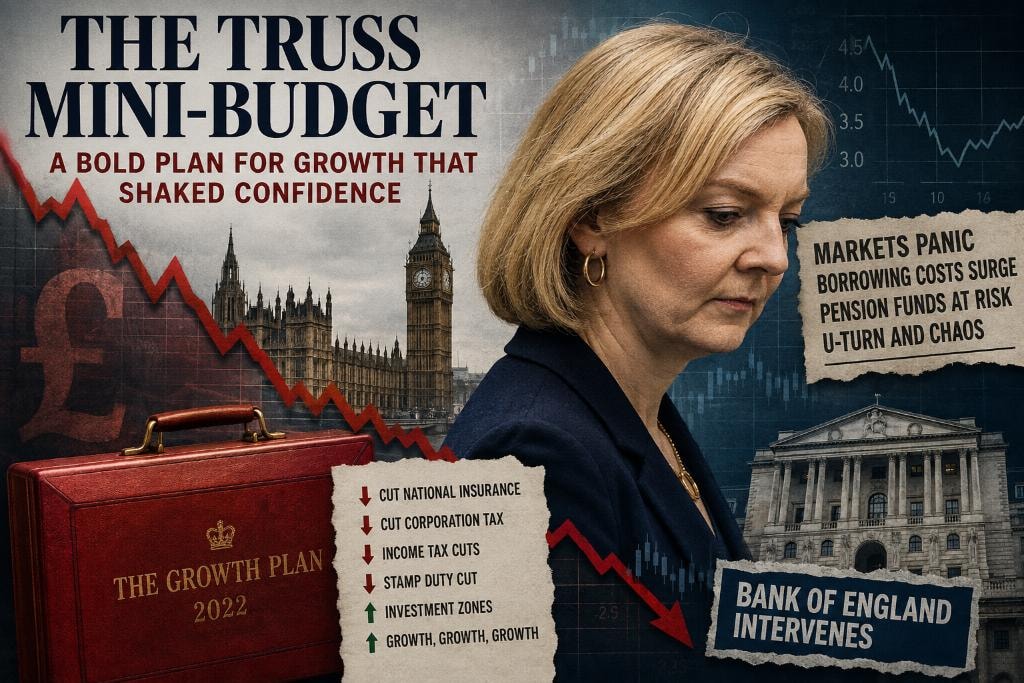
Enter Kwasi Kwarteng. On 23 September 2022, Chancellor Kwasi Kwarteng delivered what became known as the Mini-Budget, officially called The Growth Plan 2022. The word 'mini' turned out to be doing heroic amounts of work. Among the measures announced were: reversing the increase in National Insurance; cancelling the planned increase in corporation tax from 19% to 25%; bringing forward a reduction in the basic rate of income tax from 20% to 19%; abolishing the 45% additional rate of income tax; cutting stamp duty; introducing investment zones; making the £1 million Annual Investment Allowance permanent; and promising a much broader programme of supply-side reform. The permanent tax cuts eventually amounted to roughly £45 billion a year before the first reversals began.
At the same time, the Government was committing enormous sums to protecting households and businesses from soaring energy prices. So Britain was simultaneously proposing to reduce government revenue and increase government expenditure. Nobody had provided a convincing explanation of how the resulting borrowing would eventually be controlled. And there was no accompanying forecast from the Office for Budget Responsibility. That omission was devastating.
The First Unintended Consequence: The Growth Budget Increased the Cost of Growth. The Government wanted to make Britain a more attractive place to invest. Instead, investors immediately demanded a higher return for lending money to Britain. Sterling fell sharply. Gilt prices fell and yields rose. Mortgage lenders began withdrawing products. Businesses considering investment suddenly faced higher borrowing costs. Homebuyers faced higher mortgage costs. The Government itself faced higher debt-servicing costs. In other words, a package designed to lower barriers to investment helped create financial conditions that made investment more expensive. That is almost a textbook definition of an unintended consequence.
The Pension Fund Problem Nobody Expected. Many defined-benefit pension schemes used investment strategies known as Liability Driven Investment, or LDI. These arrangements frequently involved leverage and derivatives designed to match pension funds' long-term liabilities. They worked reasonably well while gilt markets behaved reasonably normally. Then gilt yields moved with extraordinary speed. Over four days from 21 September, 30-year gilt yields rose by around 140 basis points — more than twice the largest comparable move since 2000. That triggered collateral calls on leveraged LDI funds. Funds needed cash. To raise cash, they sold gilts. Selling gilts pushed gilt prices lower. Lower prices created further collateral requirements. Which required more gilt sales. A financial feedback loop had appeared.
The Bank of England later described the situation as presenting a material risk to UK financial stability. On 28 September, only five days after the Mini-Budget, the Bank intervened and began temporarily purchasing long-dated government bonds. Consider the extraordinary irony: a Conservative government had launched a programme intended to reduce the role of the state and unleash free markets. Within five days, the central bank was intervening in the government bond market to prevent financial dysfunction. Markets can have a wicked sense of humour.
But Were the Tax Cuts Actually Wrong? Several ideas contained in the Mini-Budget were perfectly defensible. Reducing corporation tax can increase the return on investment. Making investment allowances more generous can encourage capital expenditure. Reducing National Insurance lowers the tax burden on employment. Reforming planning rules could increase development. And Britain's persistent productivity problem unquestionably justified a serious discussion about supply-side reform. The lesson from 2022 should not simply be: tax cuts are bad. The much better lesson is: unfunded tax cuts introduced during an inflation crisis, without an independent fiscal forecast, while simultaneously committing enormous sums to an energy bailout, are rather different from a carefully financed programme of tax reform. That distinction has largely disappeared from the political retelling.
The Real Mistake Was Sequencing. Imagine instead that the Truss government had begun with structural reform — planning reform, infrastructure reform, investment incentives, regulatory simplification, measures to improve labour-force participation, and a credible five-year spending framework with an OBR assessment demonstrating how the public finances would remain sustainable. Then tax reductions could have followed as fiscal capacity emerged. Instead, the Government effectively announced the dessert before demonstrating that it could afford dinner. Markets were asked to believe that faster growth would eventually pay for much of the programme. But government bonds are purchased by investors, not optimists. Investors wanted numbers.
Confidence Is an Economic Asset. One of the most important lessons from the Mini-Budget is that government credibility has a financial value. Countries borrow enormous amounts of money. The UK therefore depends upon investors believing that British government debt remains safe and that fiscal policy will ultimately remain responsible. Lose that confidence and investors demand higher interest rates. Those higher rates then increase government borrowing costs. Which worsens the fiscal position. Which can require higher taxes or lower spending. Which can weaken economic growth. A government can therefore create precisely the problem it was attempting to solve. This was the fundamental failure of the Truss experiment: the Government believed economic policy was principally about incentives. The markets reminded it that economic policy is also about confidence.
Then Came the Reversal. The political retreat was astonishingly fast. On 3 October, the Government abandoned its proposal to abolish the 45% additional income-tax rate. Kwasi Kwarteng was dismissed on 14 October. Jeremy Hunt became Chancellor and systematically dismantled much of the programme. Liz Truss resigned on 20 October after only 45 days in office. By November, the economic philosophy had effectively reversed. The new approach prioritised fiscal credibility, tax revenue and reassurance.
The Second Unintended Consequence. Perhaps the greatest unintended consequence came later. Truss wanted to start a national debate about whether Britain's high-tax, low-growth economic model was sustainable. Instead, she made that debate more difficult. For years afterwards, almost any proposal involving substantial tax reductions could be answered with two words: 'Liz Truss.' The failure of one particular fiscal experiment became evidence against an entire economic philosophy. That is intellectually convenient but economically questionable. The Mini-Budget did not demonstrate that lower taxes cannot stimulate investment. It demonstrated that the method by which taxes are cut matters enormously. Timing matters. Funding matters. Inflation matters. Interest rates matter. Communication matters. Institutional credibility matters. And financial markets matter. Rather annoyingly, economics insists on having more than one variable.
The Unintended Consequences Verdict. The Truss Mini-Budget deserves criticism — but perhaps not quite for the reason usually given. Its central ambition, increasing Britain's economic growth rate, was entirely reasonable. Some of its diagnosis was arguably correct. Britain does have weak productivity. Investment does matter. Tax incentives do affect behaviour. Planning restrictions do inhibit development. And governments cannot redistribute wealth indefinitely without worrying about how that wealth is created. The failure was believing that announcing a destination was equivalent to building a road to it.
The Government tried to shock Britain into faster growth. Instead, it shocked the bond market. The bond market shocked the pension system. The pension system forced the Bank of England to intervene. The intervention intensified the political crisis. The political crisis destroyed the economic programme. And the destruction of the programme made future governments more cautious about pursuing the very supply-side reforms Truss had wanted to promote. A Budget intended to prove that Britain could afford to think radically instead taught politicians that radicalism was politically dangerous. That may be its most enduring unintended consequence.
There is also a broader lesson. Governments frequently believe that economic policy works like pulling a lever: cut tax and investment rises, raise tax and revenue rises, subsidise something and more of it appears, regulate something and the problem disappears. Real economies are complicated adaptive systems. Change one incentive and businesses, consumers, investors, banks and financial markets change their behaviour in response. Sometimes the reaction overwhelms the original policy. Liz Truss wanted to demonstrate the power of economic incentives. In a peculiar way, she succeeded. Just not the incentives she had intended.
About the author
Robert Woodland-Ferrari
Businessman, entrepreneur and lifelong observer of decisions that seemed like a good idea at the time.