In August 2020, the British Government wanted people to start going to restaurants again.
There was a problem.
For months it had been telling them not to.
The hospitality industry was in serious trouble. Restaurants, pubs and cafés had been closed during lockdown. Employees were furloughed. Businesses were burning through cash and reopening the doors didn't necessarily mean frightened customers would walk through them.
The Government needed to restore confidence.
So Chancellor Rishi Sunak came up with an extraordinarily simple idea.
Make eating out half price and let the taxpayer pick up the difference.
People responded enthusiastically. More than 160 million discounted meals were claimed. Restaurants filled. Hospitality activity increased. The scheme had achieved precisely what it was designed to achieve.
Unfortunately, there was still a highly contagious respiratory virus circulating.
And this is where our story begins.
1. What Was the Problem?
By the summer of 2020, Britain's hospitality industry had suffered an economic catastrophe. The first national lockdown had closed pubs, restaurants and cafés across the country. Government figures showed that around 80% of hospitality businesses had stopped trading during April, while approximately 1.4 million hospitality workers had been furloughed.
This presented the Government with two connected problems. The first was obvious: businesses needed customers. The second was rather more difficult: customers needed persuading to behave like customers again.
For months, the public had been given an extremely effective message: stay at home, avoid other people, don't gather indoors, protect the NHS, save lives.
Then infection levels declined, restrictions began to ease and the economic message had to change. The Government now needed people to leave their homes, visit shops, return to work and spend money. Restaurants could reopen. But opening a restaurant and having customers actually turn up are rather different things.
Consumers remained cautious. Meanwhile the furlough scheme was costing the Treasury billions. Businesses couldn't remain permanently dependent upon government support. The economy had to restart. The problem was real and something had to be done.
2. What Was the Idea?
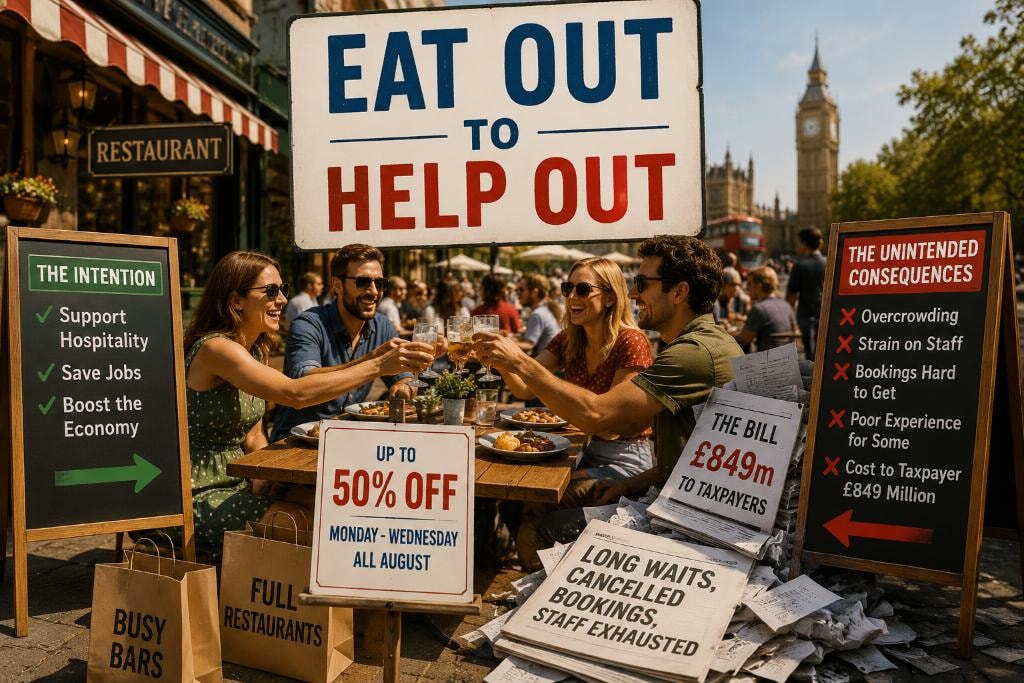
The Treasury's answer was Eat Out to Help Out. The scheme ran throughout August 2020. Visit a participating restaurant, café or pub on a Monday, Tuesday or Wednesday and the Government would pay 50% of the cost of food and non-alcoholic drinks, up to £10 per person.
There was no voucher. No means test. No complicated application for customers. No limit on how many times an individual could use it. The restaurant simply deducted the discount from the bill and reclaimed the money from HMRC.
It was beautifully simple. And simplicity matters. Government schemes often fail because they require ordinary human beings to understand seventeen pages of guidance, create an online account and remember the password. Eat Out to Help Out required you to understand one thing. Lunch was half price. Britain grasped the concept remarkably quickly.
3. Why Did It Seem Sensible?
This is important. It is very easy to look at a policy six years later and laugh at the people who introduced it. That isn't what Unintended Consequences is about. The interesting question is whether the original decision made sense at the time. And Eat Out to Help Out did.
The hospitality industry employed enormous numbers of people. Restaurants had been deprived of customers through government restrictions. The Government was already paying wages through furlough. Simply continuing to pay people not to work indefinitely wasn't a viable economic strategy.
There was even some clever economic thinking in the design. The discount applied only on Monday, Tuesday and Wednesday — traditionally quieter days for restaurants. Government therefore wasn't merely subsidising Saturday dinners people might have bought anyway. It was attempting to create additional demand when restaurants had spare capacity.
There was also a psychological objective. The Government needed to signal that Britain was reopening. Eat Out to Help Out didn't merely subsidise food. It gave people permission to start behaving normally again. As economic policy, there was a perfectly respectable argument behind it.
There was just one assumption lurking underneath it. That increasing social activity was now desirable. Economically, it was. Epidemiologically, things were slightly more complicated.
4. What Actually Happened?
Something governments don't always experience happened. The public did exactly what they were asked to do.
Eat Out to Help Out was enormously popular. More than 35 million discounted meals were claimed during the first two weeks. By the end of the scheme, more than 160 million meals had been claimed across tens of thousands of participating establishments. The final cost was around £840 million, substantially above the Treasury's original £500 million estimate.
People hadn't merely returned to restaurants. They had returned enthusiastically. Restaurant bookings surged. Tables filled. Staff returned to work. Later economic research found that areas with greater exposure to the scheme experienced increased retail and recreational footfall and higher numbers of hospitality job advertisements.
So we should be clear about something. Eat Out to Help Out worked. At least initially. The Government wanted to stimulate restaurant demand — restaurant demand increased. It wanted people to overcome their reluctance to eat out — they did. It wanted to support hospitality employment — there is evidence that employment demand increased. Judged solely against its immediate objective, this was a successful government intervention.
Which brings us to the question governments really ought to ask more often.
5. And Then What Happened?
More people went to restaurants. And restaurants have an unusual characteristic. They contain other people. People sit near one another. They talk. They eat. They drink. And because eating through a face covering has never really caught on, customers generally removed their masks.
Meanwhile Covid hadn't disappeared. The virus had no particular interest in supporting the hospitality industry. It merely exploited opportunities to spread. And the Government had just spent hundreds of millions of pounds creating millions of additional opportunities for people to spend extended periods together.
Researchers subsequently tried to establish whether this had affected Covid transmission. A University of Warwick study later published in The Economic Journal found that areas with higher participation in Eat Out to Help Out experienced increased Covid infection clusters after the scheme began. The researchers estimated that the scheme may have been responsible for somewhere between 8% and 17% of newly detected infections during the period in which it operated.
That estimate needs treating sensibly. Covid transmission was affected by many things — schools reopened, people travelled, workplaces reopened, social activity generally increased, seasonal conditions changed. Nobody can reasonably claim that Britain's second Covid wave was simply caused by discounted Tuesday-night curries. But the mechanism itself is hardly mysterious. Government subsidised indoor social activity. Indoor social activity increased. A virus transmitted through human contact gained additional opportunities to spread.
This is the moment at which the intended consequence met the unintended one.
6. How Did the Government React?
By September, infection numbers were increasing. And the Government now faced almost the reverse of the problem it had faced a few weeks earlier. In August: not enough people are going to restaurants. By autumn: too many people are mixing while Covid is spreading.
New restrictions were introduced. From 24 September, pubs, bars and restaurants were required to close at 10pm. Regional restrictions followed. Hospitality businesses again faced limits on how they could operate. Then came another national lockdown.
Consider the sequence. March: stay at home. July: please start going out again. August: we'll pay you to go out. September: please don't stay out too late. Autumn: actually, stay at home again.
The hospitality industry had travelled from compulsory closure to taxpayer-subsidised customers and back towards compulsory closure in a matter of months. Government had solved one problem. And then found itself attempting to solve a consequence of the solution.
Was the Government Wrong?
This is where the story becomes more interesting than simply declaring the whole thing ridiculous. The Government faced an extraordinarily difficult decision. Doing nothing would also have had consequences. Restaurants would have failed. Employees would have lost jobs. Suppliers would have lost customers. Landlords would have lost rent. Banks would have suffered bad debts. Government tax receipts would have fallen. Welfare expenditure would have risen. Entirely viable businesses could have disappeared because of a temporary public-health emergency.
So the question isn't: should the Government have supported hospitality? There was an overwhelming case for doing so. The better question is: was encouraging millions of additional indoor social interactions the best way to support hospitality during an infectious disease outbreak? That is much harder to defend.
What Else Could They Have Done?
The scheme eventually cost taxpayers around £840 million. That money could have supported hospitality in other ways — extended targeted grants, continued employment support, further business-rates relief, subsidised outdoor rather than indoor dining, funding for awnings, heaters, temporary structures and pavement seating, or support linked to lost turnover.
None of these alternatives would have been perfect. Every government intervention creates distortions of its own. But there is an important difference between supporting a business and paying customers to participate in an activity carrying a public-health risk. A grant says: here's some money to help you survive. Eat Out to Help Out effectively said: here's some money, provided lots of people come through your door. Normally that's precisely what a restaurant needs. August 2020 wasn't normal.
The Economic Benefit Didn't Last Either
There was another problem. The increase in economic activity was largely temporary. Later research found that Eat Out to Help Out increased footfall and hospitality job advertisements while the scheme operated. But the effects faded. That shouldn't surprise anyone. Government temporarily reduced the price of restaurant meals. People bought more restaurant meals. Government stopped subsidising them. Prices returned to normal. People adjusted their behaviour again.
This exposes an important distinction. Stimulating economic activity isn't necessarily the same as creating economic growth. The Government had successfully purchased additional restaurant demand with taxpayers' money. That may have been justified as emergency support. But it wasn't a permanent improvement in productivity, investment or economic capacity. When the subsidy disappeared, much of the additional activity disappeared with it.
The Unintended Consequences Verdict
Eat Out to Help Out deserves a place in the Unintended Consequences collection precisely because it wasn't an obviously stupid policy. The problem was genuine. The objective was reasonable. The economic logic was understandable. The scheme was simple. Consumers understood it. Businesses embraced it. And it successfully changed behaviour. That was the problem.
The Government wanted more people to go to restaurants. It created a powerful incentive. More people went to restaurants. More people spending time together indoors created more opportunities for Covid transmission. Research subsequently found evidence of increased infections associated with the scheme. Cases rose. Restrictions returned. Hospitality suffered again. And government found itself once more supporting an industry it had recently paid customers to support.
The Lesson: Keep Asking 'And Then What?'
Perhaps the greatest weakness in policymaking is the tendency to stop thinking once the desired outcome has been identified. We have a problem. Hospitality is collapsing. We need a solution. Get customers back into restaurants. How? Make restaurants cheaper. What happens? People go to restaurants. Excellent. Policy approved.
But that is where the analysis should begin, not end. Because the next question is: and then what happens? People spend more time indoors together. And then what happens? Transmission opportunities increase. And then what happens? Cases may rise. And then what happens? Restrictions may have to return. And then what happens? The businesses we were trying to save lose their customers again.
That is the chain that matters. And the principle applies far beyond Covid. Raise employment taxes — and then what happens? Control rents — and then what happens? Subsidise energy — and then what happens? Ban something — and then what happens? Cancel half a railway — and then what happens?
Human beings, businesses and markets react to incentives. They don't politely remain stationary while governments alter one variable. That is why good intentions are never enough. And it is why the most useful person in any Cabinet meeting might not be the economist, the strategist or the communications adviser. It may simply be the irritating person sitting at the end of the table who keeps asking: 'And then what happens?' And when everyone has answered: 'And then what happens after that?' Keep going. Because somewhere around the fourth answer is usually the consequence nobody intended.
The UC Verdict: The Problem: Britain's hospitality industry was collapsing after lockdown. The Idea: Give consumers a 50% discount to encourage them back into restaurants. Why It Made Sense: Restart demand, protect jobs and rebuild consumer confidence. What Happened: It worked spectacularly — more than 160 million discounted meals were claimed. And Then What Happened? Millions of additional indoor social interactions occurred while Covid was still circulating, with subsequent research linking the scheme to increased infections. The Reaction: Within weeks, hospitality restrictions began returning. The Unintended Consequence: The Government successfully encouraged the very social activity it shortly afterwards needed to restrict. A policy that didn't fail because people ignored it. A policy that got into trouble because people did exactly what they were encouraged to do.
About the author
Robert Woodland-Ferrari
Businessman, entrepreneur and lifelong observer of decisions that seemed like a good idea at the time.