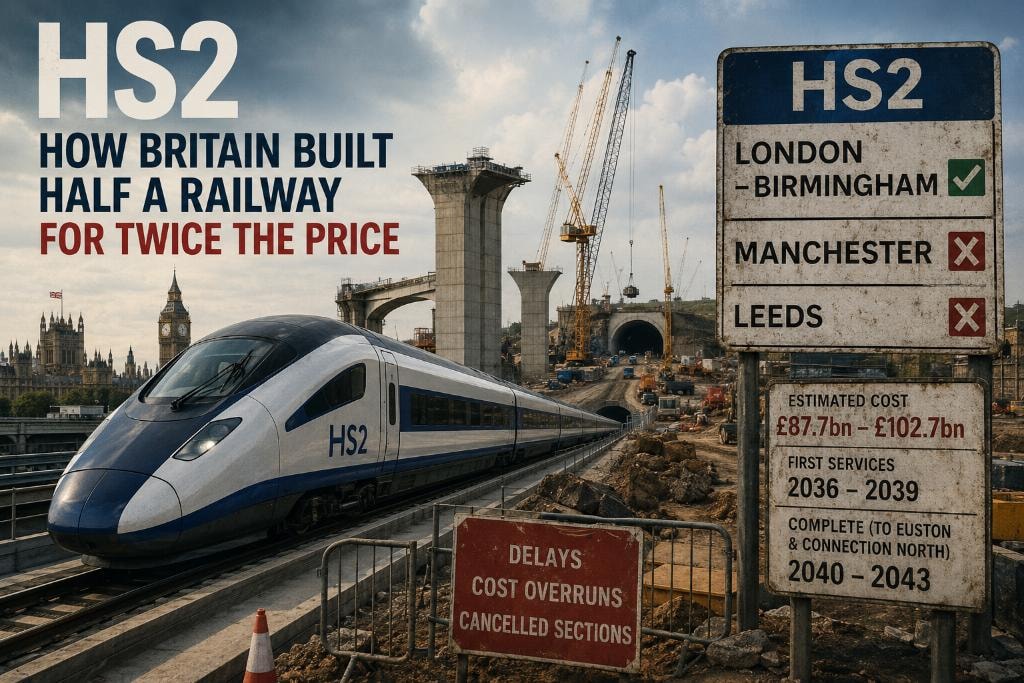
There is a particular kind of British infrastructure project that begins with a map, a minister and an impressively round number. HS2 had all three. The original proposition was compelling. Britain's main north-south railways were becoming increasingly congested. Building additional capacity on the existing network would be difficult and disruptive. So instead of continually patching Victorian infrastructure, Britain would build a new railway. And if you were going to build a new railway, why not make it fast?
HS2 would link London with Birmingham, Manchester and Leeds, release capacity on existing lines, shorten journey times and help address the enormous economic gravitational pull of London. It was infrastructure on a national scale. It was also supposed to demonstrate that Britain could still build things. That last ambition has not aged particularly well.
By May 2026, the Government estimated that completing the remaining HS2 programme would cost between £87.7 billion and £102.7 billion, with first services from Old Oak Common to Birmingham expected between 2036 and 2039. The complete surviving scheme, including Euston and the connection north of Birmingham, is expected between 2040 and 2043. And this is after much of the railway originally proposed has been cancelled. HS2 therefore presents us with a fascinating unintended consequence: Britain attempted to solve a transport capacity problem and ended up creating a national argument about whether Britain is capable of delivering major infrastructure at all.
The original idea was not stupid. It is tempting, with hindsight, to describe HS2 as an obviously ridiculous project dreamed up by politicians fascinated by trains travelling at 225mph. That misses the point. The underlying problem was real. The West Coast Main Line carries long-distance passenger trains, commuter services and freight. Mixing different types and speeds of train on the same railway consumes capacity. HS2 offered another railway. Long-distance services could move onto the new high-speed line, freeing paths on the existing railway for commuter, regional and freight services. The speed was useful. But capacity was arguably the more important benefit.
There was another objective. Britain has spent decades worrying about the economic dominance of London and the South East. HS2 was supposed to help change that. Connect Birmingham, Manchester and Leeds more effectively to each other and to London, improve access to labour markets, encourage investment and suddenly infrastructure becomes part of regional economic policy. Hence the great political promise: HS2 would help rebalance Britain. That was the theory. Then Britain started building it.
Unintended Consequence No. 1: The railway became about speed rather than capacity. Calling it High Speed 2 may have been one of the project's first strategic mistakes. It gave opponents an obvious question: is saving 20 or 30 minutes on a journey really worth tens of billions of pounds? That is a much harder political argument to win than: Britain needs another north-south railway because the existing network is running out of capacity. Speed became the headline benefit. And therefore speed became the easiest benefit to attack. The project gradually acquired the image of an expensive executive railway allowing businessmen to reach Birmingham slightly earlier. Yet releasing capacity on existing railways was one of the most important reasons for building it. The branding distorted the argument.
Unintended Consequence No. 2: Trying to make the railway acceptable made it much more expensive. Britain is densely populated. Building a railway through it inevitably means encountering houses, farms, businesses, ancient woodland, protected landscapes, councils, MPs, campaign groups and people who understandably do not want a railway at the bottom of their garden. The political solution was mitigation: more tunnels, more cuttings, more noise barriers, more environmental protection, more compensation, more engineering. Each decision could be defended individually. Together they became extraordinarily expensive. The National Audit Office noted that requirements imposed on HS2 included increased tunnelling and noise barriers, while also warning that the complexity and risks of the programme had been underestimated.
This illustrates one of the recurring problems with British infrastructure. We want infrastructure. We simply don't particularly want to see it. So we bury it, screen it, redesign it and compensate people for it. Then we complain that infrastructure costs too much. Human beings have developed a remarkably efficient system for demanding two contradictory things simultaneously.
Unintended Consequence No. 3: The budget became a political promise rather than an engineering forecast. Large infrastructure projects contain enormous uncertainty. Ground conditions change. Designs evolve. Planning requirements increase. Land prices move. Construction costs rise. Contracts change. Yet governments understandably want to announce a number. The number then acquires political significance. Soon it stops being an estimate and becomes a promise. HS2 demonstrated the danger beautifully. The National Audit Office repeatedly warned about unrealistic assumptions. It concluded that government and HS2 Ltd had underestimated the programme's complexity and risk and that contingency arrangements had been inadequate.
The latest assessment is even more uncomfortable. In May 2026, the Transport Secretary told Parliament that the surviving programme was expected to cost £87.7 billion to £102.7 billion. The Government attributed roughly two-thirds of the increase to missed scope, underestimation and inefficient delivery, with the remaining third associated with inflation. In other words, this wasn't simply unfortunate inflation. A substantial part of the problem was that the original understanding of what was being built, how long it would take and how much it would cost was wrong.
Unintended Consequence No. 4: Delaying the project to save money helped make it more expensive. When costs rise, governments naturally try to control spending. One obvious response is to slow construction. The Treasury spends less money this year. Problem solved. Except the project still exists. Staff remain employed. Sites must be maintained. Contracts need renegotiating. Inflation continues. Supply chains are disrupted. Equipment sits idle. Restarting work costs money. The National Audit Office warned about precisely this problem when work at Euston was paused. It said the pause would defer expenditure in the short term but could increase overall costs because of stopping and restarting work, contractual changes and the cost of managing the project for longer. So the attempt to reduce the annual cost can increase the eventual cost. A Treasury saving can become a taxpayer loss.
Unintended Consequence No. 5: Cancelling half the railway didn't cancel half the cost. In October 2023, the Conservative Government cancelled Phase 2 between the West Midlands and Manchester. The argument was straightforward: costs had risen too far, travel patterns had changed, continuing could no longer be justified. Politically, cancellation looked like stopping waste. Economically, the calculation was more complicated. Billions had already been spent. Land had been purchased. Design and preparatory work had been completed. Contracts had been entered into. And the remaining railway still required enormous infrastructure between London and Birmingham. The northern sections were gone. Much of the sunk cost was not.
The Government had spent around £2 billion on Phase 2 work before its cancellation. Even closing the cancelled project costs money — the National Audit Office estimated that shutting down Phase 2 would take around three years and cost up to £100 million. The Public Accounts Committee subsequently concluded that the reduced scheme represented very poor value for money. Which gives us a rather magnificent unintended consequence: cancelling part of HS2 to improve value for money may have made the value-for-money calculation of what remained worse.
The railway to the North that doesn't go to the North. This is perhaps the strangest outcome. HS2 was sold partly as an instrument of regional regeneration. Manchester and Leeds were central to that argument. Yet Leeds disappeared from the plan first. Manchester followed. What survives is principally a high-speed railway between London and Birmingham, eventually connecting into the existing West Coast Main Line. The infrastructure project designed to demonstrate Britain's commitment to the North was substantially curtailed before reaching it. The political geography of the project changed while it was being built. That matters because infrastructure benefits depend on networks. A bridge is useful because it reaches the other side. Sometimes the missing section was the reason for building the first section in the first place.
Then there is Euston. No story of HS2 would be complete without the peculiar achievement of building a railway from London while struggling to decide exactly where in central London it should terminate. Building a huge new station in central London while maintaining existing railway operations was inevitably complex. But complexity became redesign. The original concept changed. Budgets changed. Platform numbers changed. Construction was paused. By March 2023, the estimated cost of the then 10-platform Euston design had reached £4.8 billion, around £2.2 billion above its budget. The current plan still intends HS2 eventually to reach Euston, with private finance expected to play a role. Until then, the first HS2 services are expected to terminate at Old Oak Common — several miles west of London's intended central terminus. It would be difficult to invent a better metaphor for the project.
Why didn't somebody stop it earlier? The problems did not suddenly appear in 2023. Warnings existed years earlier. The National Audit Office reported that HS2 Ltd formally advised the Department for Transport in March 2019 that Phase One could not be delivered on time or within its available funding. Yet the project continued. Because stopping a major government project is politically much harder than starting one. Once billions have been spent, cancellation looks like admitting that billions have been wasted. Once contracts have been signed, cancellation itself becomes expensive. Once construction begins, thousands of jobs depend upon it. The project therefore develops institutional momentum. This creates one of the most dangerous phrases in government: we've already spent too much to stop now. Eventually that can be followed by its equally dangerous cousin: it's become too expensive to continue. HS2 managed to experience both.
Was HS2 itself the mistake? Not necessarily. Britain needed additional rail capacity. Britain still needs better transport infrastructure. Britain still has a productivity problem outside London. The failure of HS2 therefore shouldn't automatically lead to the conclusion that ambitious infrastructure is a mistake. That would be another unintended consequence. If politicians learn from HS2 that large projects are politically dangerous, future governments may simply avoid them. Roads don't get built. Railways don't get built. Reservoirs don't get built. Power stations don't get built. Housing doesn't get built. Everything becomes too difficult. Eventually the country saves enormous amounts of money by not building anything and then wonders why productivity refuses to improve. The correct lesson is not don't build. It is build differently.
The £100 billion question. By March 2026, £44.2 billion had already been spent on HS2. The latest estimated cost of completing the surviving programme is up to £102.7 billion. And the National Audit Office says the reset itself will not be fully completed until 2027. Remarkably, therefore, after years of construction and tens of billions already spent, Britain is still establishing the final reliable baseline for the cost and timetable. The NAO's June 2026 assessment says costs have roughly doubled compared with the 2020 estimate and warns that government must avoid putting revised plans into action until it is confident that the programme can actually deliver against them. That may be the most important lesson of the entire affair: don't start building until you properly understand what you're building. It sounds almost insultingly obvious. Apparently it isn't.
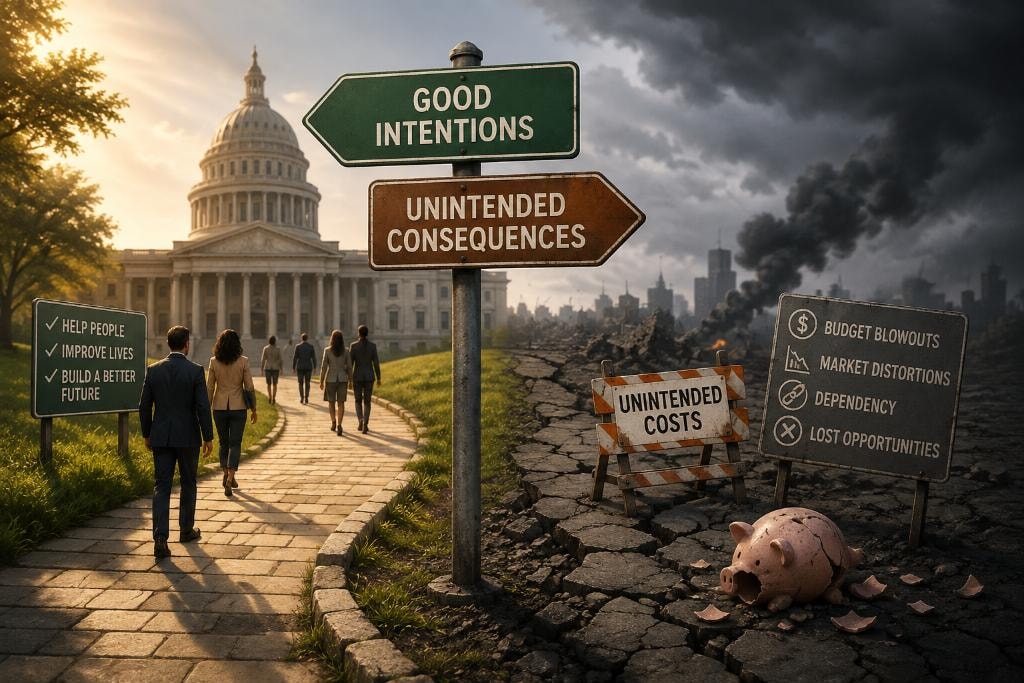
The real unintended consequence. HS2 was intended to increase confidence in Britain's economic future. Instead it damaged confidence in Britain's ability to deliver infrastructure. It was intended to connect the North and South. The northern sections were cancelled. It was intended to demonstrate long-term strategic thinking. It became hostage to short-term political decisions. Attempts to reduce its environmental impact increased costs. Attempts to reduce annual expenditure caused delays. Delays increased costs. Rising costs encouraged cancellation. Cancellation reduced the benefits of the remaining railway. And reduced benefits made the remaining cost harder to justify. Each decision had its own logic. Together they created something nobody originally intended.
There was no single moment when somebody decided: let's spend approaching £100 billion building a much smaller railway than originally planned, open it decades later than expected and make the country deeply suspicious of major infrastructure projects. Quite the opposite. Successive governments were usually trying to solve the problem immediately in front of them — reduce the environmental damage, keep the budget under control, delay expenditure, redesign the station, cut the expensive section, protect the taxpayer. Every intervention was intended to make HS2 more manageable. Collectively, many of them helped make it less so. And that is perhaps the purest example of an unintended consequence. HS2 wasn't destroyed by one spectacularly stupid decision. It was gradually transformed by hundreds of apparently sensible ones.
About the author
Robert Woodland-Ferrari
Businessman, entrepreneur and lifelong observer of decisions that seemed like a good idea at the time.