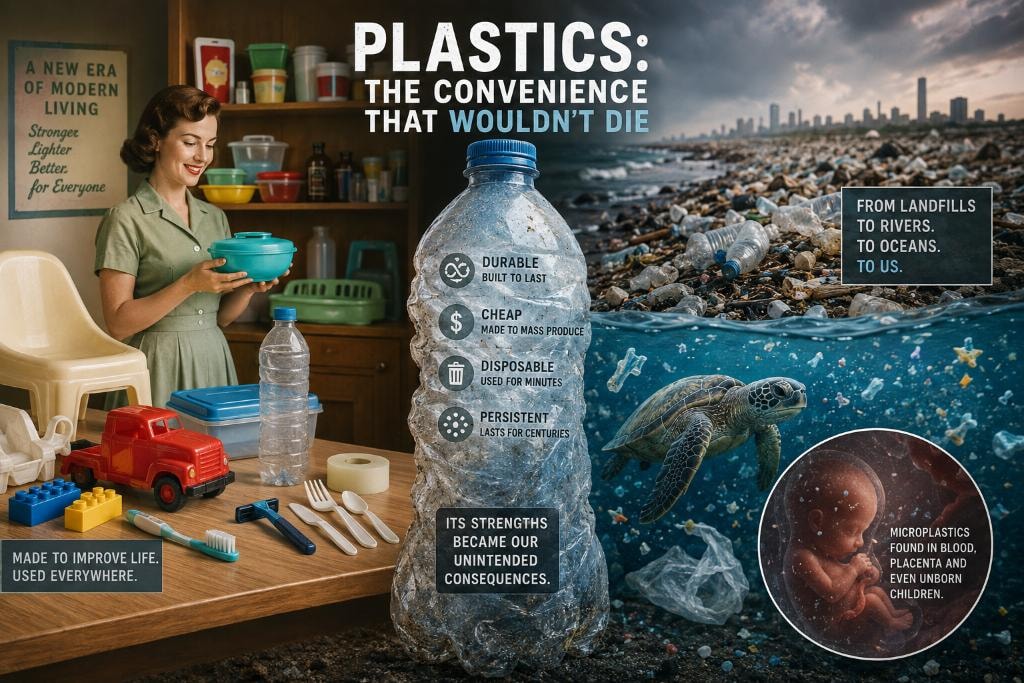
Plastic solved an extraordinary number of human problems. Cheap, sterile, light, durable and almost infinitely adaptable, it became one of the foundations of modern life. Unfortunately, we designed a material to last for decades and then used much of it to make things intended to last for minutes.
There are few inventions that demonstrate the law of unintended consequences quite as perfectly as plastic.
Plastic was not a bad invention. Quite the opposite.
It helped make modern medicine possible. It reduced the weight of cars and aircraft. It insulated electrical wiring, preserved food, protected clean water, replaced scarce natural materials and made thousands of everyday products affordable to ordinary people.
Plastic was, in many respects, the great equaliser of twentieth-century consumerism.
The problem was hidden inside the very qualities that made it miraculous.
Plastic was cheap. Plastic was durable. And plastic could be manufactured by the billion.
We consequently created an economic system in which an extraordinarily persistent material became so inexpensive that we could afford to throw it away.
The unintended consequence was almost inevitable.
The Material That Changed Everything
Before plastics became widespread, the physical world was remarkably different.
Milk came in glass bottles. Shopping was carried in paper bags. Toys were made from wood, metal or fabric. Food was wrapped in paper, wax or tins. Household goods were manufactured from ceramics, glass, steel, leather and timber.
These materials worked, but they had disadvantages. Glass broke. Metal rusted. Wood rotted. Natural materials could be expensive.
Then came plastics.
The development was gradual. Early plastics such as Bakelite appeared in the early twentieth century, but the enormous expansion came after the Second World War as petrochemical manufacturing grew.
Suddenly manufacturers had access to materials that could be moulded into almost any imaginable shape. Polyethylene. PVC. Polystyrene. Polypropylene. PET. Each offered slightly different properties, and industry discovered thousands of applications.
Production exploded. The OECD estimates that global plastics production rose from around 2 million tonnes in 1950 to 460 million tonnes in 2019, a roughly 230-fold increase.
Plastic did not conquer the world because governments forced people to use it. It conquered the world because it was extraordinarily useful.
The Benefits Were Real
It is easy, looking at today's environmental problems, to portray plastic as an obvious mistake. That would be rewriting history.
Plastic packaging dramatically improved food hygiene and shelf life. Lightweight packaging reduced transportation costs. Disposable medical equipment reduced infection risks. Plastic pipes provided inexpensive water infrastructure. Electrical insulation improved safety.
Cars became lighter partly because plastics replaced heavier materials, reducing fuel consumption.
Even environmental conservation sometimes benefited. Early synthetic plastics reduced demand for materials such as ivory, tortoiseshell and animal horn.
And perhaps most importantly, plastic made products cheaper. Items once made from expensive materials could suddenly be mass-produced for millions of households. Radios. Telephones. Kitchen equipment. Furniture. Children's toys. Clothing. Computers. Medical devices. Consumer electronics.
Plastic became one of the invisible foundations of rising living standards.
So where did we go wrong? Not principally in inventing plastic. We confused durability with disposability.
A Material Designed to Last, Used Once
Consider the absurdity of the modern plastic bottle. Oil and gas formed underground over millions of years. We extract the hydrocarbons. Transport them. Refine them. Turn them into polymers. Manufacture a bottle. Fill it. Transport it again. Refrigerate it. Sell it. Someone drinks the contents in perhaps ten minutes. The bottle may then remain somewhere in the environment for decades or centuries, gradually fragmenting rather than simply disappearing.
We created extraordinary industrial sophistication to manufacture an object whose useful life might be shorter than the journey home from the supermarket.
Economically, however, it made perfect sense. The bottle was cheap. And therein lies the problem.
Cheapness Changed Human Behaviour
When something has value, humans tend to preserve it. When something is almost worthless, we discard it.
Our grandparents washed glass bottles because bottles had value. Modern consumers throw packaging away because the packaging costs almost nothing.
Plastic therefore changed more than manufacturing. It changed behaviour. Disposable cups. Disposable cutlery. Disposable razors. Disposable bags. Disposable packaging. Disposable food containers.
Eventually we reached the peculiar situation where manufacturers were using one of the most durable materials ever invented to manufacture products specifically designed to become rubbish almost immediately.
The economic benefit belonged to the producer and consumer. The environmental cost belonged to everybody else. Economists have a wonderfully sanitised expression for this. An externality. It means someone else gets the bill.
The Recycling Solution
Eventually governments recognised the problem. The answer appeared obvious. Recycle it.
Consumers were encouraged to sort their rubbish into different containers. Recycling symbols appeared on packaging. Councils introduced recycling collections. The psychological message was reassuring. Buy it. Use it. Recycle it. Problem solved.
Except it wasn't.
Plastic recycling is considerably more complicated than recycling materials such as aluminium or glass. Different polymers have different properties. Packaging can contain multiple materials. Food contamination creates problems. Dyes and additives complicate processing. Some plastics degrade when recycled and cannot repeatedly be returned to equivalent products.
Most importantly, producing new plastic can simply be cheaper than recovering old plastic.
The numbers reveal the scale of the problem. Of approximately 353 million tonnes of plastic waste generated worldwide in 2019, only about 9% was ultimately recycled. Around 19% was incinerated and almost half went into sanitary landfill. The remainder was mismanaged, openly burned or leaked into the environment.
Even the recycling figure needs qualification. About 55 million tonnes were collected for recycling in 2019, but roughly 22 million tonnes became recycling residue requiring some other form of disposal.
There is a considerable difference between putting something into a recycling bin and actually recycling it.
Humans had invented another wonderfully comforting system in which the bin disappearing from the pavement could easily be mistaken for the problem disappearing with it.
The Problem Became Invisible
Traditional pollution was obvious. Smoke emerged from factory chimneys. Sewage floated down rivers. Industrial waste accumulated beside factories.
Plastic pollution is more deceptive. A plastic object does not necessarily disappear when it breaks apart. It becomes smaller. And smaller. Eventually microscopic.
These fragments are known as microplastics, with even smaller particles described as nanoplastics. They can originate from discarded packaging, synthetic clothing fibres, tyre wear, industrial pellets, paints and countless other sources.
The OECD estimated that around 22 million tonnes of plastics leaked into the environment in 2019, with microplastic leakage including particles produced by tyre and road-marking abrasion and synthetic textile fibres.
Plastic had escaped the waste system. It had entered the environment itself.
Then We Started Finding It Inside Us
Perhaps the most unsettling development came when researchers began detecting micro- and nanoplastics in human biological samples.
Researchers have reported them in blood and placental material, and research continues into how particles enter the body and what biological effects they may have. A 2025 laboratory study involving human placental cells found inflammatory, cytotoxic and endocrine effects from nanoplastic exposure, although translating laboratory findings into actual population-level health risks requires considerably more research.
That distinction matters. Finding plastic particles inside humans does not automatically demonstrate that they are causing widespread disease. Science has established exposure much more clearly than it has established the precise health consequences.
But the extraordinary fact remains. A material that barely existed in everyday life a century ago is now sufficiently widespread that scientists can detect its microscopic remnants within the human body. The pollution problem is no longer merely something floating in the Pacific. It has crossed the boundary between the environment and biology.
The Unborn Generation
Perhaps nothing captures the unintended consequence more powerfully than the placenta.
Plastic-related particles have been detected in placental material, and researchers are investigating possible effects during pregnancy and early development.
Consider what that means historically. A child conceived today enters a biological environment fundamentally different from that experienced by a child born in 1900.
Not because anyone deliberately decided this should happen. No government voted for plastic particles to become part of human exposure. No chemical company set out with that objective. No consumer purchasing a bottle of water intended it.
It emerged from billions upon billions of individually rational decisions. That is precisely how unintended consequences usually work. Nobody planned the outcome. Everybody contributed to it.
Why Didn't We Stop?
Because stopping made very little economic sense. Plastic was cheap. Alternatives were often heavier, more expensive or less effective. Consumers liked convenience. Retailers liked longer shelf lives. Manufacturers liked low production costs. Governments liked economic growth. Petrochemical companies liked growing demand.
Everyone received an immediate benefit. The environmental cost arrived somewhere else, sometime later. That is a dangerous combination.
Politics is particularly poor at dealing with problems where the benefits are immediate and the costs arrive decades later. A government restricting cheap packaging today receives complaints today. The environmental benefit might not become visible for twenty years. Democracy rather inconveniently operates on election cycles rather than geological ones.
And Production Keeps Growing
Perhaps the most disturbing part of the story is that this is not primarily a historical problem. It is a growing one.
The OECD projects that, without stronger policies, global plastic waste could rise from 353 million tonnes in 2019 to more than one billion tonnes annually by 2060.
Recycling is projected to improve. But even under the OECD baseline projection, only about 17% of plastic waste would be recycled in 2060.
In other words, improving recycling alone may not solve a problem whose underlying volume continues to expand. We could become better at emptying the bath while simultaneously turning up the taps.
The Difficult Truth About Plastic
There is another uncomfortable point. We cannot simply eliminate plastic.
Modern hospitals could barely function without it. Sterile syringes, blood bags, tubing, protective equipment, pharmaceutical packaging and countless medical devices depend upon polymers. Food waste might increase without effective packaging. Cars and aircraft could become heavier. Electronics would become more difficult and expensive to manufacture. Water infrastructure depends heavily upon plastic pipes. Renewable-energy technologies themselves use polymers and composites.
The challenge therefore isn't: How do we abolish plastic? It is: Why are we using extraordinarily durable materials for applications where durability has almost no value?
A heart valve lasting decades is a triumph. A takeaway fork lasting centuries is not.
Perhaps We Priced It Wrong
The deeper unintended consequence may therefore be economic rather than technological.
Plastic became extraordinarily cheap because its market price reflected the cost of manufacturing it. But not necessarily the full cost of dealing with it afterwards.
Imagine if every piece of plastic included in its price the eventual cost of collecting, sorting, recycling or safely disposing of it. Manufacturers would suddenly have an incentive to use less. Packaging would become simpler. Reusable systems might become more competitive. Consumers would respond to different prices. And innovation would move towards alternatives.
This is why policies such as producer responsibility schemes are potentially important. Instead of taxpayers and councils carrying the entire disposal cost, producers retain some responsibility for what happens to products after consumers have finished with them.
It subtly changes the question from: "Can we manufacture this cheaply?" to: "Can we manufacture, recover and reuse this efficiently?" Those are very different economic incentives.
The Next Unintended Consequence
There is, however, one final warning. Solving the plastic problem badly could create another one.
Replace plastic packaging with heavier glass and transportation emissions can increase. Replace synthetic materials indiscriminately with paper and demand for forests and water may increase. Ban certain packaging and food waste could rise. Replace lightweight plastic components in vehicles with heavier materials and energy consumption could increase.
Environmental policy is particularly vulnerable to moving a problem from one column of the spreadsheet to another and declaring victory.
The lesson from plastic therefore isn't simply that plastic is bad. It is that systems matter. Every alternative carries costs. The objective should be to reduce total environmental harm, not merely whichever form of harm currently attracts the most attention.
The Convenience That Wouldn't Die
Plastic deserves its place among humanity's great inventions. It transformed medicine. It transformed manufacturing. It transformed food distribution. It transformed transportation. It transformed ordinary household life. Billions of people benefited.
And that is exactly why the problem became so enormous. A useless invention can do little damage because nobody uses it. The inventions capable of producing truly enormous unintended consequences are usually the successful ones.
We became extraordinarily good at manufacturing plastic. We became extraordinarily good at selling it. We became extraordinarily good at throwing it away. We were considerably less successful at answering the rather obvious question: Where exactly is "away"?
There is no away. There is only somewhere else. A landfill. A river. An ocean. A field. The atmosphere. And increasingly, perhaps, ourselves.
The twentieth century's miracle material solved countless problems because it refused to disappear. The twenty-first century's problem is exactly the same. It refuses to disappear.
The Unintended Consequence
The intention: Create an inexpensive, durable, hygienic and versatile material capable of replacing heavier, fragile and expensive alternatives.
The success: Plastic revolutionised medicine, manufacturing, transport, food preservation and consumer goods while making products affordable to billions.
The consequence: We made permanence almost worthless, used it to manufacture disposable objects by the trillion, and created a waste stream that the natural world cannot conveniently absorb.
The lesson: The greatest danger is sometimes not that a technology fails, but that it succeeds on a scale its inventors never imagined.
About the author
Robert Woodland-Ferrari
Businessman, entrepreneur and lifelong observer of decisions that seemed like a good idea at the time.