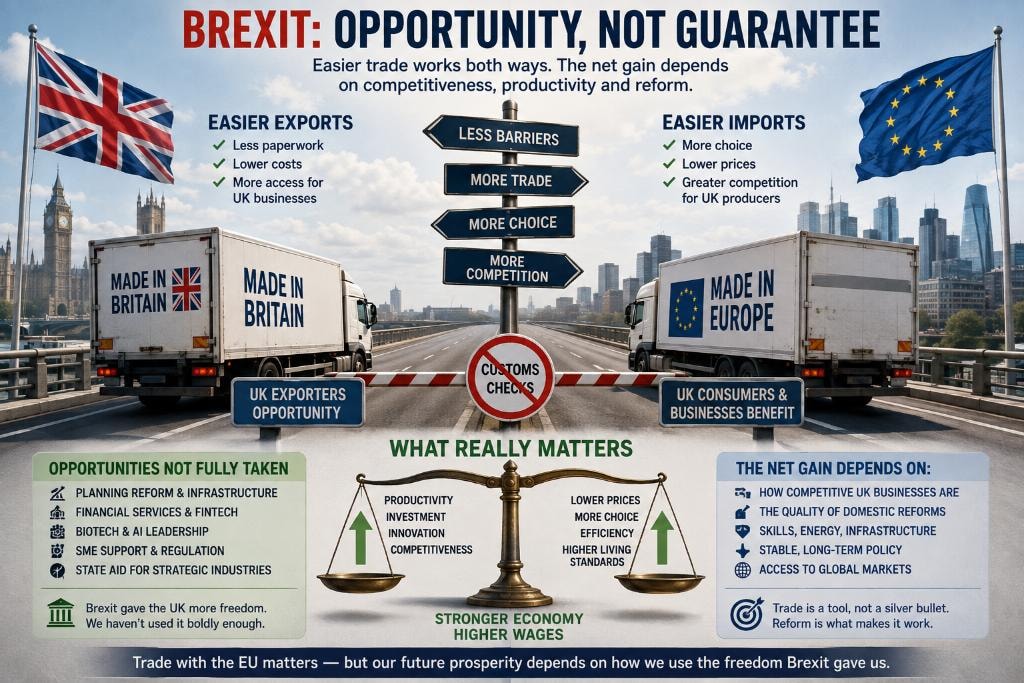
One of the biggest criticisms of successive UK governments after Brexit is not that they failed to 'do Brexit', but that they failed to exploit the regulatory freedom that Brexit created. Instead of rapidly redesigning large parts of the economy, they largely copied EU rules into UK law and changed relatively little. Politicians spent years arguing about Brexit rather than using it. Humans are remarkably talented at winning an argument and then forgetting to cash the cheque.
Here are the major missed opportunities.
1. Planning and House Building. This was arguably the biggest opportunity. Outside the EU, Britain had complete freedom to overhaul planning rules, environmental assessments and procurement. The Government could have simplified planning approvals, reduced judicial reviews delaying projects, introduced automatic planning zones, and accelerated nuclear plants, reservoirs, roads and rail. Instead, housebuilding remained around 200,000–250,000 annually, infrastructure approvals remained painfully slow, and the planning system is still regarded as one of the biggest constraints on UK growth. Potential gain: higher GDP, cheaper housing, greater productivity.
2. Financial Services. The City of London generates enormous tax revenues. Brexit allowed Britain to create a more competitive financial regime than the EU — simpler listing rules, a faster IPO process, more attractive investment funds, easier capital raising, faster fintech regulation. Some reforms happened, including changes following the UK Listings Review and adjustments to insurance capital rules, but critics argue they were modest rather than transformational.
3. AI and Technology Regulation. The EU has tended towards precautionary regulation. Britain could have become Europe's AI capital, an autonomous vehicle leader, a gene editing leader, a fintech leader, a digital health leader. There has been movement, especially on AI, but no sweeping deregulatory agenda that many Brexit supporters expected.
4. Biotechnology. The UK has world-class universities. Brexit enabled independent regulation of gene editing, agricultural biotech, pharmaceuticals and medical devices. Some progress has occurred, such as legislation permitting precision breeding in England, but many argue the pace has been slower than expected.
5. VAT Reform. Outside the EU VAT Directive, Britain gained greater flexibility — lower VAT on energy, reduced VAT on hospitality, simplified VAT thresholds, reform of business rates alongside VAT, major simplification for SMEs. Very little comprehensive reform followed.
6. Farming. The Common Agricultural Policy ended. The opportunity was to pay farmers for environmental improvements, food security, productivity and innovation. The UK introduced the Environmental Land Management scheme, but the transition has been controversial and many farmers say uncertainty has hindered investment.
7. Fisheries. One of Brexit's symbolic issues. The potential was for stronger UK quota control, a modern fishing fleet, fish processing investment and coastal regeneration. In reality, fishing rights changed only gradually under the Trade and Cooperation Agreement, and many in the industry felt expectations exceeded the practical gains.
8. Procurement. The UK could simplify public procurement — easier SME access, faster contracts, less paperwork, innovation-focused procurement. The Procurement Act 2023 aims to simplify the system, but implementation has taken time and its long-term impact remains to be seen.
9. State Aid. EU state-aid rules no longer applied in the same way. The opportunity was to support semiconductor manufacturing, battery factories, AI, defence and green technology. Instead, governments were generally cautious, partly because the UK-EU trade agreement still places some limits on subsidy policy and because ministers wanted to avoid costly subsidy races.
10. Civil Service Regulation. Thousands of retained EU laws could have been reviewed. Instead of asking 'Would we write this law today?', the Government often left regulations unchanged. The Retained EU Law Act ultimately preserved most inherited legislation rather than replacing it wholesale.
11. Labour Market. The UK could have simplified employment law, working-time rules, holiday calculations and agency-worker regulations. Governments made very few significant changes, partly because reducing employment protections is politically contentious.
12. Immigration. Freedom of movement ended. The opportunity was to design a system matching skills shortages. The UK introduced a points-based immigration system, but legal migration reached record highs in the years after Brexit, showing that ending free movement did not automatically reduce overall immigration.
Areas where change did happen. It would be unfair to say nothing changed. Examples include independent trade agreements (though economic gains are generally expected to be modest compared with EU trade), precision breeding legislation, freeports, Solvency UK reforms for insurers, procurement reform, the Windsor Framework for Northern Ireland, and more flexible AI governance compared with the EU's AI Act.
Why were so many opportunities missed? Several factors contributed: political caution — governments feared the economic disruption of sweeping deregulation; civil service incentives — existing rules were familiar and lower risk than redesigning them; business preferences — many exporters wanted continued alignment with EU standards to reduce compliance costs; limited parliamentary time — Brexit negotiations and related legislation dominated the agenda for years; and frequent changes of leadership — the UK had several prime ministers and policy resets in a short period, making long-term reform difficult.
The broader debate. Supporters of Brexit often argue that the UK gained the freedom to tailor regulation to its own economy but failed to use that freedom decisively. In this view, the issue is less Brexit itself than the lack of ambition in post-Brexit policymaking. Critics respond that many hoped-for gains were always overstated. They argue that because the EU remains the UK's largest trading partner, substantial divergence carries costs for exporters, so extensive deregulation is neither straightforward nor necessarily beneficial.
The reality probably sits between these positions. Brexit undeniably created new policy choices in areas such as agriculture, procurement, biotechnology and financial regulation. The debate is whether governments have made the most of those choices, and many analysts across the political spectrum agree that the UK has pursued incremental rather than transformative change.
On the question of trade: there are arguments for the opportunities to sell into the EU because of easier export paperwork, which would increase exports for smaller businesses. But this is neutralised by easier imports. The net gain depends on what else changes alongside trade. If the UK simply restores easier trade with the EU while leaving planning, energy costs, skills, tax and regulation unchanged, the overall economic gain is likely to be positive but modest.
If, however, easier trade is combined with domestic reforms that make UK firms more productive, then those firms are in a better position to win market share both at home and abroad. An analogy: imagine two neighbouring shopping centres separated by a fence. Removing the fence makes it easier for your customers to visit the other centre — and equally easier for their customers to visit yours. If your shops are attractive, you gain business. If they are tired and expensive, you lose business. Removing the fence does not determine the outcome. The quality and competitiveness of what is behind the fence does.
That is why many economists argue that trade policy and domestic economic policy are complements. Trade barriers matter, but so do planning laws, infrastructure, energy prices, skills, taxation and innovation. Without improvements in those areas, lowering trade frictions alone is unlikely to deliver dramatic gains. Conversely, domestic reforms can have a much larger impact when businesses can sell easily into large export markets. The debate is less about whether trade matters, and more about which combination of openness and domestic reform best supports long-term growth.
About the author
Robert Woodland-Ferrari
Businessman, entrepreneur and lifelong observer of decisions that seemed like a good idea at the time.