Political parties are supposed to defeat their opponents. Occasionally, however, they manufacture them.
The extraordinary falling-out between Nigel Farage and Rupert Lowe began as an internal dispute inside Reform UK. It involved disagreements about leadership, allegations about Lowe's behaviour, the withdrawal of the Reform whip and ultimately a police investigation. It might have ended with Lowe disappearing into the political wilderness. Instead, by 2026, Rupert Lowe was leading his own political party, Restore Britain, competing for many of exactly the same voters as Reform UK. In one significant parliamentary contest, the division on the populist right was already helping Labour. The unintended consequence is difficult to miss. Reform removed a troublesome MP. It may have created a troublesome competitor. And the story raises a much bigger question about political leadership: When does removing a dissident make an organisation stronger, and when does it merely create an enemy who knows exactly where all the weaknesses are?
Rupert Lowe entered Parliament at the 2024 general election as Reform UK's MP for Great Yarmouth. He was not initially Reform's biggest problem. Quite the opposite. Lowe became one of the party's more prominent parliamentary figures and developed a substantial following among voters who wanted Reform to take an even tougher approach to immigration and the size of the state. But tensions developed between Lowe and the leadership. The dispute became public in March 2025 after Lowe criticised the way Reform was being run and questioned whether the party could progress from being a protest movement into a credible party of government. Most significantly, he questioned Farage's dominance. This was dangerous territory.
Farage was not simply Reform's leader. He was overwhelmingly its best-known political asset. The party's identity, media coverage and electoral appeal had become closely associated with him. Lowe's criticism therefore struck at something fundamental. Could Reform become a serious national political organisation while remaining so dependent upon one man? Farage responded publicly, criticising Lowe's behaviour and referring to complaints concerning his conduct. Reform subsequently announced that Lowe had been reported to the police over alleged threats towards the party chairman, Zia Yusuf, and the whip was withdrawn. Lowe denied the allegations and said he was the victim of a campaign to remove him after criticising Farage. Suddenly, a political disagreement had become something much more serious.
Reform said there were complaints about Lowe's treatment of staff and alleged verbal threats against Yusuf. These were serious matters and could not simply be ignored. The difficulty for Reform was that the disciplinary process became entangled with the political dispute. Lowe argued that his removal was not really about his conduct but about his challenge to Farage's leadership. Reform rejected that interpretation. The distinction matters. If an organisation investigates somebody because credible complaints have been made, that is responsible governance. If disciplinary procedures appear to coincide conveniently with somebody becoming politically inconvenient, outsiders inevitably begin wondering whether the two things are connected. That perception became particularly damaging when the criminal element of the affair reached its conclusion.
In May 2025, the Crown Prosecution Service announced that Lowe would not face criminal charges over the alleged threats. After considering witness statements and the available evidence, prosecutors concluded that there was insufficient evidence to provide a realistic prospect of conviction. That did not establish that every allegation concerning Lowe was false. The separate allegations concerning workplace behaviour were different from the alleged threats considered by prosecutors, and Reform said an independent investigation had found evidence supporting complaints about Lowe's conduct. Lowe disputed that process and its conclusions. But politically, nuance rarely survives contact with a headline. The simple version was much more powerful: Reform reported Lowe to the police. Lowe was removed. The authorities subsequently decided there was insufficient evidence to prosecute him. For Lowe, that was political ammunition.
He portrayed the affair as an attempt to silence a critic. By May 2025 he was saying Farage should "never be prime minister", while also pursuing legal action against Farage, Lee Anderson and Zia Yusuf over statements he said had damaged his reputation. The internal disagreement was now irreparable. And this is where the unintended consequences really began.
Reform had removed Lowe from the party. But it had not removed Lowe from politics. This is an important distinction organisations frequently overlook. Expelling someone removes their internal power. It does not necessarily remove their external influence. Indeed, sometimes it increases it. Inside Reform, Lowe had been one MP among several. Outside Reform, he could become something different: the man prepared to say that Reform itself had become part of the establishment. That was potentially dangerous because Reform's entire political proposition depended upon presenting itself as the insurgent alternative to establishment politics. Lowe could now attack Reform from precisely the same direction Reform had attacked the Conservatives. The revolutionary suddenly had its own revolutionaries.
Lowe initially established Restore Britain as a political movement before formally launching it as a national political party in February 2026. Restore positioned itself to the right of Reform on several issues, particularly immigration. This created a fascinating political problem for Farage. For years his electoral advantage had come partly from occupying political territory that the Conservative Party was reluctant or unable to occupy. Reform could say: The Conservatives talk about immigration. We will actually do something about it. Now Lowe could apply essentially the same argument to Reform: Reform talks tough. Restore will actually go further. The challenger had acquired a challenger.
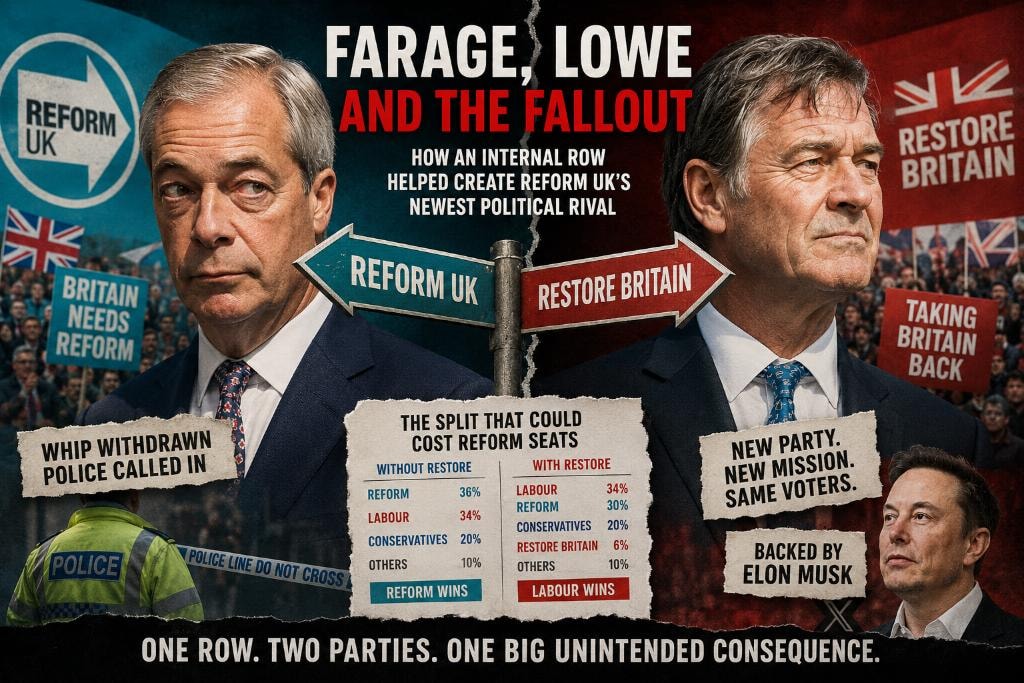
Britain's first-past-the-post electoral system punishes divided political movements mercilessly. A party does not need 50 per cent of the vote to win a constituency. It merely needs more votes than everybody else. Imagine a constituency where the result might otherwise be: Reform 36%, Labour 34%, Conservative 20%, Others 10% — Reform wins. Now introduce Restore Britain. Suppose just six percentage points move from Reform to Restore: Labour 34%, Reform 30%, Conservative 20%, Restore 6%, Others 10% — Labour wins. Nothing about Labour has improved. Nothing about Reform's combined ideological support has necessarily declined. The opposition has simply divided itself. This is precisely why political splits can be so destructive. And by June 2026 this was no longer merely theoretical. Reuters reported Restore polling at around 7–8 per cent during the crucial Makerfield contest, with the division between Reform and Restore strengthening Labour's position.
In August 2026, Lowe offered Farage an olive branch. He proposed cooperation between Restore and Reform, subject to several political conditions, arguing that their previous disagreements should be put aside. Think about what had happened. A year earlier the relationship had deteriorated so badly that Lowe lost the Reform whip, was reported to the police and launched legal proceedings. Now the two political camps were discussing whether they needed some form of cooperation because fighting each other risked allowing their mutual opponents to win. This is almost a laboratory experiment in unintended consequences. Stage One: Remove the internal challenger. Stage Two: The challenger establishes a rival organisation. Stage Three: The rival organisation takes some of your voters. Stage Four: Both sides discover that electoral mathematics may require them to cooperate again. Politics occasionally takes the scenic route back to where it started.
From Reform's perspective, there was a perfectly rational argument for acting. Political parties cannot tolerate endless internal warfare. Farage was trying to transform Reform from an insurgent campaign into a potential party of government. That requires discipline. A leader cannot have senior MPs publicly questioning his competence every few weeks. Nor could Reform simply ignore serious complaints concerning an MP's behaviour. There was therefore an understandable objective: Protect the party, establish discipline and prevent internal disputes overwhelming its political message. The intended consequence was a more unified Reform UK. The actual consequence was rather different.
The crucial error may have been confusing organisational control with political control. Farage could control whether Lowe remained inside Reform. He could not control what Lowe did afterwards. And Lowe possessed several useful assets: a parliamentary seat, media recognition, financial resources, a following on social media and political credibility with precisely the type of voter Reform needed. Removing him did not destroy those assets. It liberated them. Instead of Lowe arguing inside Reform for a more radical agenda, he could now build an organisation outside Reform offering exactly that agenda. That distinction is enormously important.
There was another unintended consequence. Lowe attracted support from Elon Musk, who had already publicly clashed with Farage and suggested that Reform needed a different leader. By 2026 Musk was associated with backing Lowe and Restore Britain, providing the new movement with something most political start-ups desperately lack: attention. A disagreement involving one MP had therefore expanded into something much larger. Reform was no longer simply competing with Labour and the Conservatives. It was facing competition on its own political flank from a party led by one of its former MPs and amplified by one of the world's most influential businessmen. That presumably wasn't in the original risk assessment.
There is a broader lesson here. Farage's greatest strength may also be Reform's greatest structural weakness. He is extraordinarily effective at attracting attention, defining political arguments and connecting with voters who believe conventional politicians ignore them. But a political organisation built heavily around one dominant personality faces a difficult transition. A protest movement benefits from a charismatic leader. A governing party needs an institution. It needs capable ministers, internal debate, succession planning, policy specialists and enough confidence to tolerate disagreement. The Conservative and Labour parties have survived disastrous leaders precisely because they are larger than any individual. Reform has had to prove that it can eventually do the same. The Lowe affair exposed that problem earlier than Farage might have wanted.
None of this means Restore Britain will replace Reform. Far from it. Farage remains vastly better known nationally and Reform has an established electoral organisation, councillors, MPs, donors and substantial media exposure. Restore faces the traditional problem confronting political breakaways. It must convert enthusiasm into infrastructure. Social-media followers are not constituency associations. Online membership claims are not ballot-box votes. And political movements built around dissatisfaction can discover remarkably quickly that their own supporters are capable of becoming dissatisfied with them too. There is a certain symmetry there. Restore could therefore fail electorally while still damaging Reform. Indeed, that may be the most important point. Lowe does not need to beat Farage to hurt him. He merely needs to take enough votes from Reform in enough marginal constituencies.
There is another possible unintended consequence. For years Reform threatened to split the Conservative vote. Conservative MPs complained that even where Reform could not win seats itself, it could take enough votes to allow Labour or the Liberal Democrats to win. Now Reform faces precisely the same problem. Restore can do to Reform what Reform did to the Conservatives. The political insurgent is discovering one of the disadvantages of becoming established: Eventually somebody else gets to call you the establishment.
There is a useful lesson here beyond politics. Businesses encounter the same phenomenon. A difficult executive leaves and starts a competitor. A salesperson is dismissed and takes customers with them. A founder forces out a co-founder who subsequently raises money elsewhere. A company suppresses internal criticism only to discover that the criticism was identifying a genuine weakness. The instinctive response to dissent is often: Remove the dissenter and the problem disappears. Sometimes it does. Sometimes the problem walks out of the building carrying its contacts, knowledge, reputation and motivation with it. The better question is: What happens the day after we remove them? That is the question Reform perhaps should have considered more carefully.
In the short term, Farage did win. Lowe was removed from Reform and Farage retained control of the party. But the longer-term result is considerably less clear. Lowe was not prosecuted over the alleged threats. He remained an MP. He established Restore Britain. He attracted external backing and publicity. He created an alternative destination for voters dissatisfied with Reform. And by 2026 the division on the right had become electorally significant enough for the possibility of cooperation between Farage and Lowe to be discussed. Farage therefore won the organisational battle. Whether he won the political war is another matter.
The irony is almost perfect. Reform UK wanted discipline. It got a rival. It wanted to remove an internal threat to Farage's authority. It helped create an external threat that Farage could no longer control. And it wanted to demonstrate that Reform was capable of becoming a serious party of government rather than merely another protest movement. The dispute instead exposed questions about personality, governance, internal democracy and the party's dependence upon its leader. Most importantly, the split threatens to divide the very electorate Reform needs if it is ever to turn impressive opinion polling into parliamentary power. The intended objective was consolidation. The unintended consequence was fragmentation.
And now Lowe and Farage face an exquisitely awkward choice. They can continue attacking each other and risk handing constituencies to political opponents neither wants to see in government. Or they can cooperate and explain why two men who spent much of the previous year portraying each other as fundamentally unsuitable political partners should suddenly ask their supporters to work together. There may be an even larger irony waiting in the wings. For years Nigel Farage demonstrated that a smaller party does not actually have to win many parliamentary seats to transform British politics. It merely has to threaten a larger party with losing enough votes in the right places. Rupert Lowe appears to have learned the lesson. Perhaps rather too well. The ultimate unintended consequence of the Farage-Lowe fallout may therefore be this: Nigel Farage spent years perfecting the political weapon of splitting somebody else's vote, only to help create a man capable of using exactly the same weapon against him.
About the author
Robert Woodland-Ferrari
Businessman, entrepreneur and lifelong observer of decisions that seemed like a good idea at the time.